
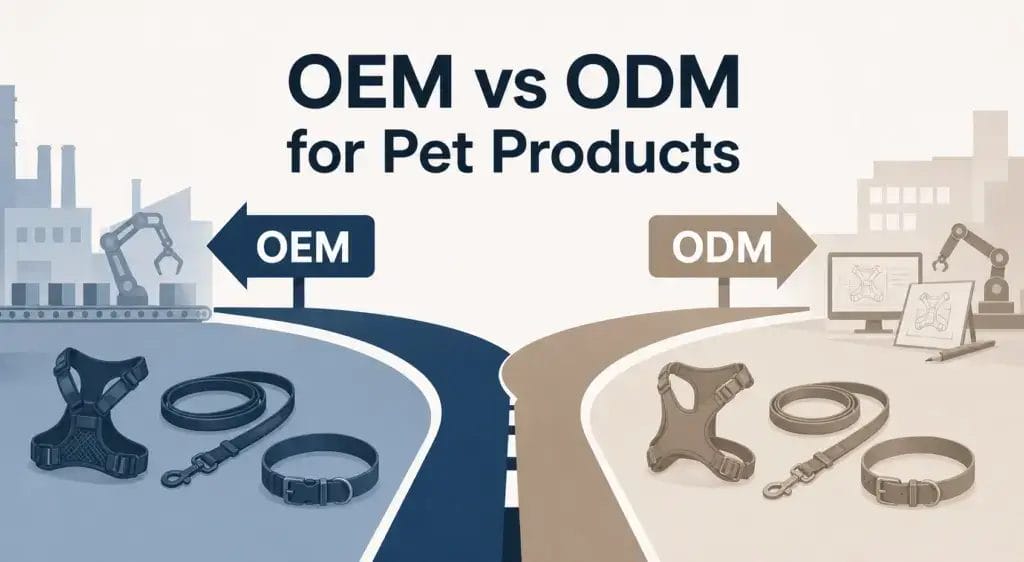
OEM and ODM describe two different starting points for getting a pet product made. With OEM (Original Equipment Manufacturer), you bring the design and specifications, and the factory builds to them. With ODM (Original Design Manufacturer), the factory already owns a base product, and you adapt it with your branding and limited changes. The model that suits a given project depends less on budget alone than on three practical questions: how unique the product needs to be, who needs to own the design, and what compliance risks the product carries in its target markets.
Most buyers already know the rough definitions by the time they start sourcing. The harder question is which model applies to the specific product in front of them — and that is what the rest of this guide works through.
For a broader overview of the pet product sourcing process that frames this decision, see our pet product OEM sourcing guide.
What OEM and ODM mean in pet product manufacturing
In an OEM arrangement, the buyer supplies the concept, technical specifications, materials list, and structural details. The manufacturer’s job is execution: turning those documents into samples, then into production. The buyer owns the design.
In an ODM arrangement, the manufacturer has already developed a product — the tooling exists, the structure is proven, the unit has been made before. The buyer selects from that catalog and customizes within boundaries the factory sets: logo, colorway, packaging, sometimes a minor structural tweak. The manufacturer owns the underlying design. In many ODM projects the buyer still owns its logo, packaging artwork, and brand-specific assets, while the factory retains ownership of the base product structure.
The point most often misunderstood: ODM is not “no customization,” and OEM is not “the factory does nothing creative.” A good ODM partner will adjust meaningfully within its existing platform, and a good OEM partner contributes engineering judgment even when the buyer owns the concept. The line between the two is about design ownership, not about how much work each side does.
The core difference: who owns the design
Everything else follows from this. If you own the design, the factory cannot sell that exact product to anyone else, and you can move the design to another manufacturer later if you need to. If the factory owns the design, the same base product can appear under several brands, and you are tied to that factory for as long as you sell it.
This matters in two practical situations. The first is differentiation: if your product is visually or functionally identical to something a competitor can buy from the same factory, the only thing separating you on the shelf is your logo and your price. The second is exit risk: an ODM product cannot easily be re-sourced, because the design does not travel with you.
For a buyer building a long-term brand, design ownership is usually the variable that decides the model — not the development cost. If exclusivity matters, it should be defined in the supply agreement, not assumed from a quotation or the sampling process.
OEM and ODM compared across six factors
| Factor | OEM | ODM |
|---|---|---|
| Design control | Full — the buyer defines structure, materials, and features | Limited — customization within the factory’s existing platform |
| Design ownership / IP | Buyer owns the design and can re-source it | Factory owns the base design; shared across its clients |
| Development time | Longer — sampling and tooling start from zero | Shorter — the product already exists and is proven |
| Minimum order quantity | Often higher, especially when new tooling, materials, or setup are required | Often lower, since tooling is already amortized |
| Certification responsibility | The buyer’s specifications drive which test reports and material declarations the product needs | The factory’s existing test reports form the starting point, but only for the product as it already makes it |
| Product exclusivity | Exclusive to the buyer’s brand | Non-exclusive unless the factory agrees otherwise in writing |
| Best fit | Unique or strategic SKUs where ownership and differentiation matter | Faster-launch SKUs built on a proven structure |
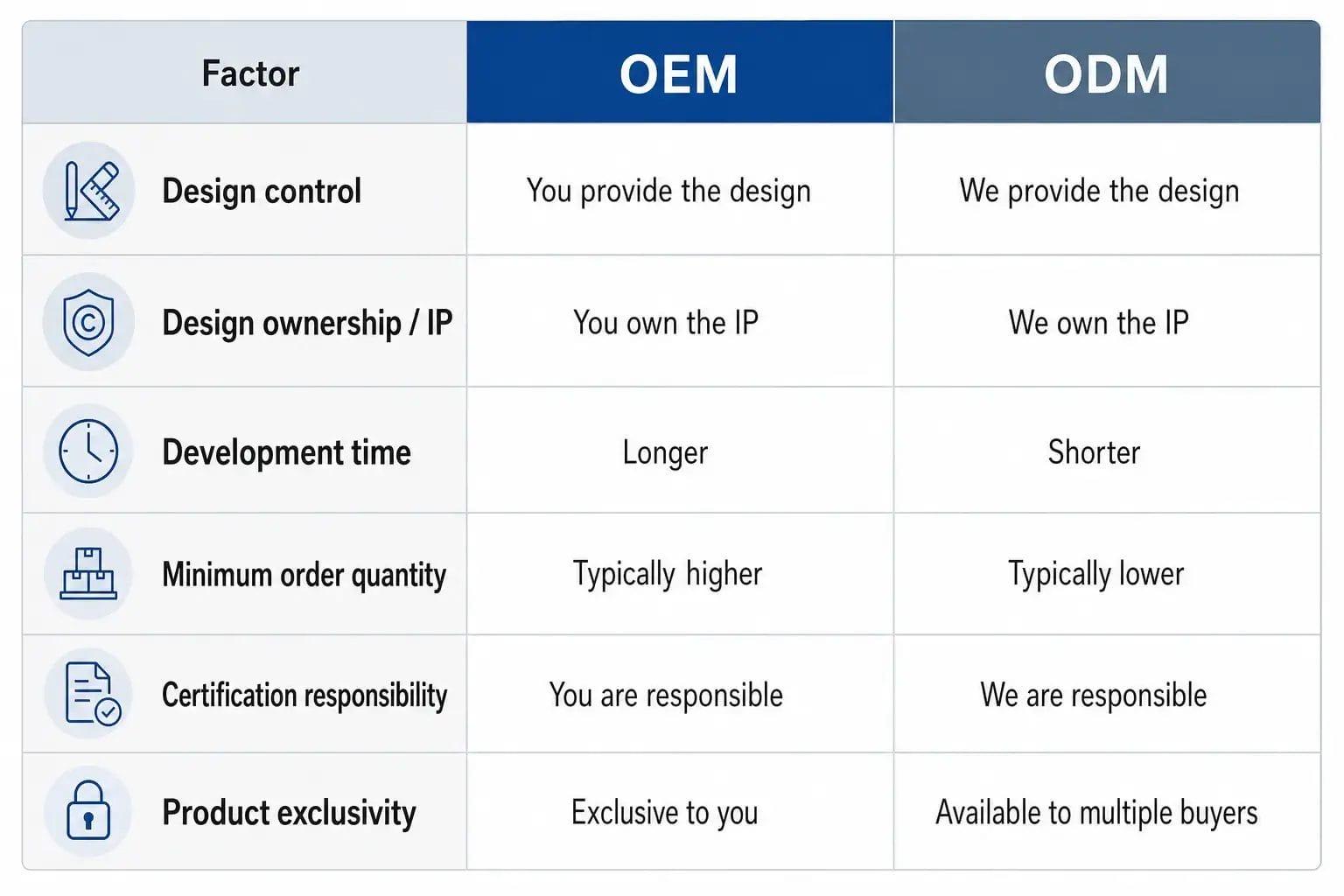
MOQ behaves differently in each model because the cost structures are different. ODM spreads existing tooling across many clients, so the entry quantity is usually easier; OEM has to recover tooling and setup from the buyer’s own order. How MOQ is calculated, and what makes it negotiable, is covered in How Pet Product MOQ Is Calculated.
Where certification responsibility sits in each model
This is the factor buyers most often overlook, and it has real consequences when a product ships to a regulated market.
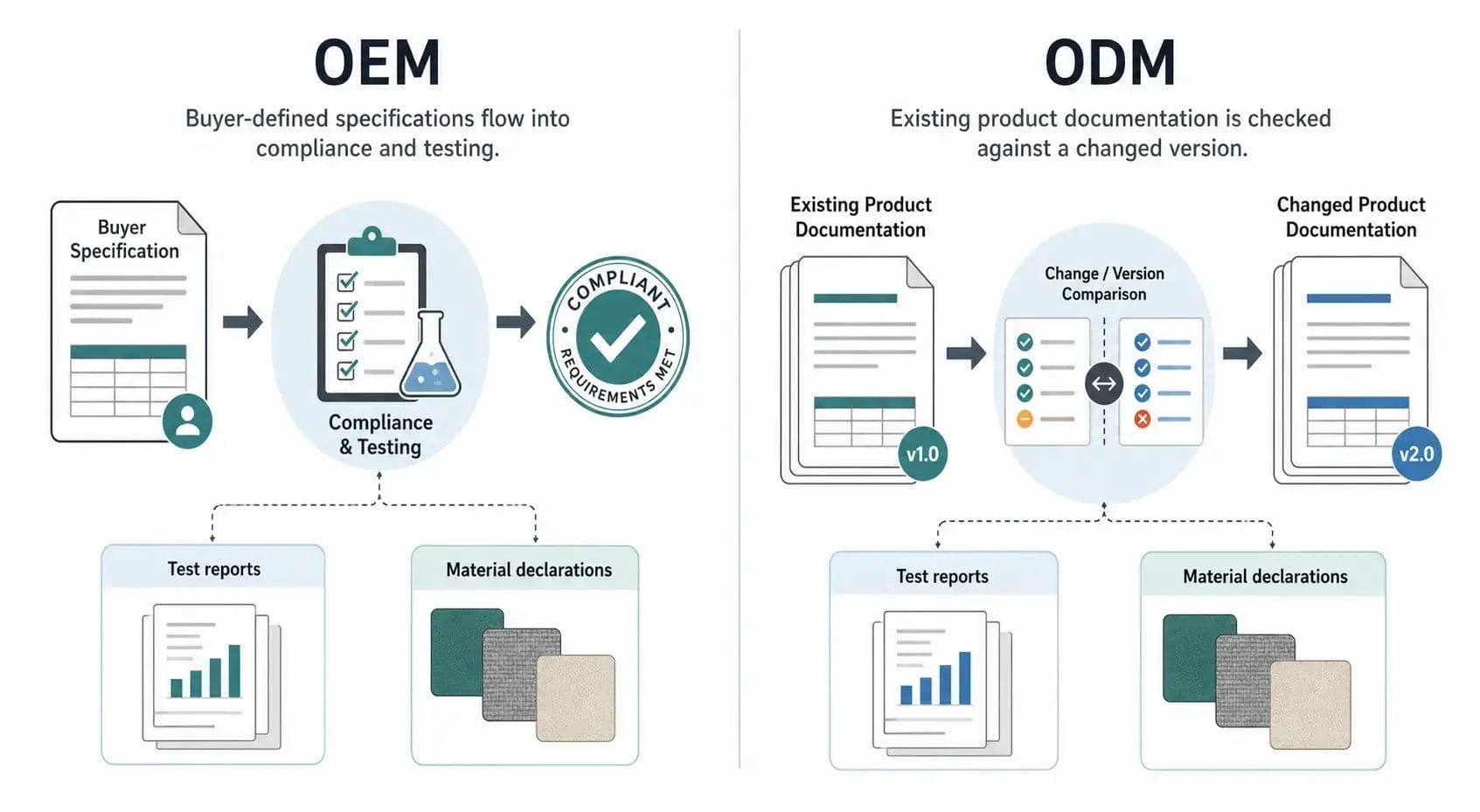
Under OEM, the buyer’s specifications define what the product is made of. That means the compliance scope — which substances are restricted, which test reports are needed — follows the buyer’s material choices. If a specified material fails a California Proposition 65 (Prop 65) or REACH requirement, the buyer needs to know before tooling is committed, not after.
Under ODM, the factory’s existing product already has a compliance history. A factory that regularly exports to the United States or the EU will usually have test reports on file for its base design. That is genuinely useful — but the reports cover the product as the factory makes it. The moment you change a material, a coating, or a component, the existing reports may no longer apply to your version.
In both models, the brand, importer, or market operator placing the product into a target market generally needs to confirm it is supported by the right documentation. The factory can reduce that risk by providing valid test reports and flagging material or component changes early, but existing documents should still be checked against the exact version being shipped. Which standards apply to which markets — Prop 65 in the United States, REACH in the EU, and others — is covered in Pet Product Compliance by Market.
The hybrid approach: ODM structure with OEM customization
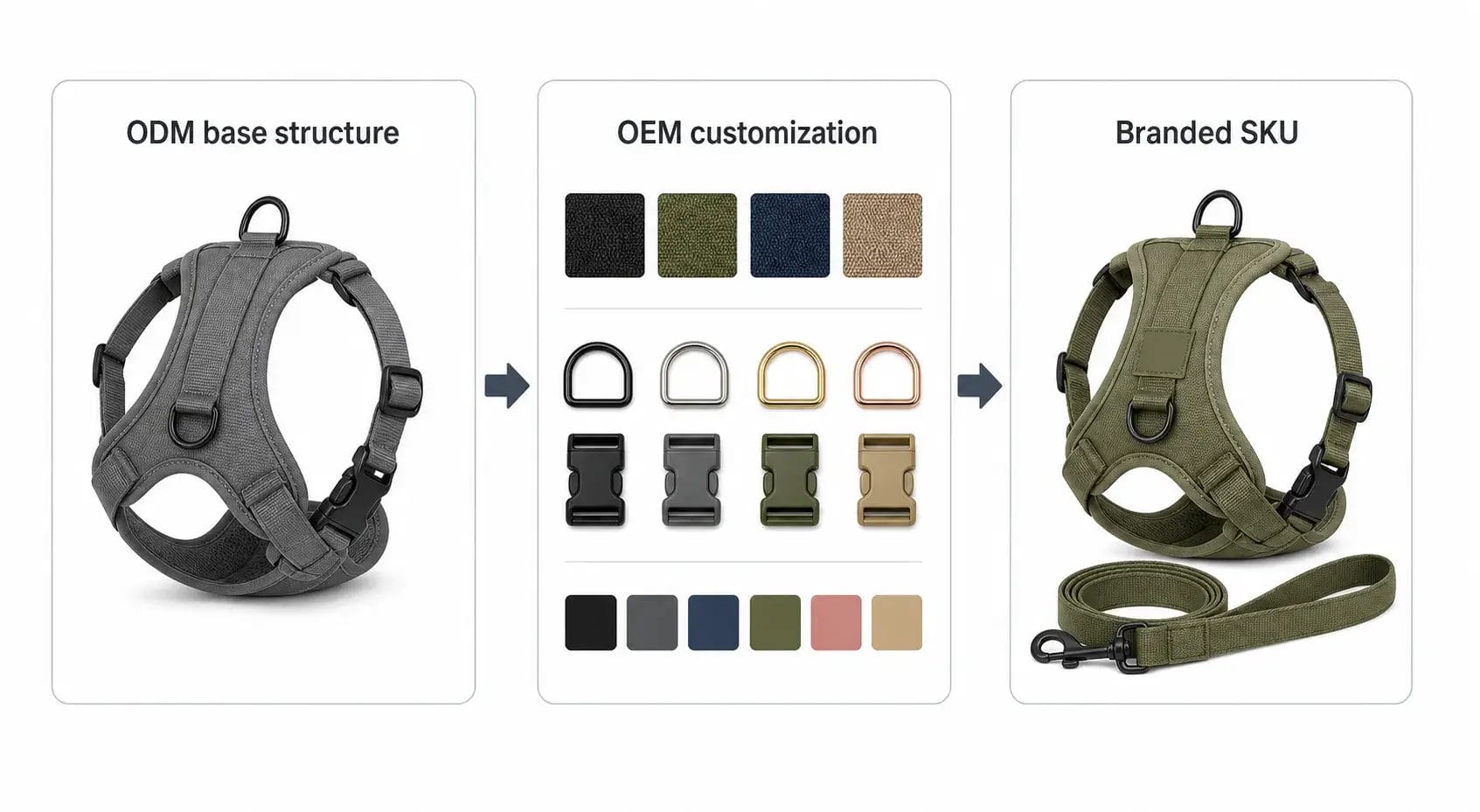
Buyers are often presented with OEM and ODM as a binary. In practice, a capable manufacturer can combine them, and for many projects the combination is the most sensible route.
The common form is an ODM structure with OEM-level material or feature changes. The factory’s proven base product is kept — its tooling, its structural engineering, its production know-how — which removes most of the development time and tooling cost. On top of that base, the buyer specifies its own materials, colors, hardware, or a functional addition that makes the product distinct enough to defend on the shelf. For soft goods such as harnesses, leashes, collars, and fabric-based accessories, this often means keeping a proven construction while changing the fabric, webbing, trims, hardware, stitching details, or functional add-ons.
This works well when the base structure is sound and the buyer’s real need is differentiation rather than a fundamentally new mechanism. It works less well when the product idea genuinely does not exist yet — at that point there is no base to start from, and the project is OEM by definition.
A hybrid project still needs a clear written agreement on what the buyer owns. The buyer’s materials and features may be exclusive while the underlying structure remains the factory’s. Getting that boundary in writing avoids disputes later.
How to decide: questions to ask before you choose
For most pet brands the decision is not OEM or ODM for the whole catalog. It is usually made SKU by SKU: ODM for fast-moving accessories built on proven structures, a hybrid route for products that need real differentiation, and OEM for the hero SKUs where ownership matters most. The model follows the product, not the brand.
With that in mind, a few concrete questions help place any single product:
- Does the product need to be exclusive to your brand? If it does, OEM or a clearly defined hybrid model fits better. If a branded version of a proven product is acceptable for this SKU, ODM works.
- Do you have, or can you produce, full specifications? OEM is workable when materials, structure, dimensions, and tolerances are already defined. With a direction but no specification, ODM or a hybrid is more realistic.
- How fast do you need to be in market? A proven ODM product can ship sooner; an OEM product from zero takes longer because sampling and tooling start fresh.
- Will you want to move production elsewhere later? If re-sourcing flexibility matters, you need to own the design — which means OEM.
- Which markets will the product enter? The answer shapes material choice, testing scope, and documentation, regardless of model.
A manufacturer that asks these questions before quoting is working as a sourcing partner. One that pushes a single model without understanding the project is usually optimizing for its own production line, not for your brand. How to tell those two apart is covered in How to Choose a Pet Product OEM Manufacturer.
CrazyPaws supports OEM and hybrid development for pet product categories including pet harnesses and leashes and collars. For a specific SKU where the OEM, ODM, or hybrid route is still open, the development team can review the product concept, target market, customization needed, and compliance considerations before sampling begins.
FAQ
What is the difference between OEM and ODM in one sentence?
OEM means you provide the design and own it; ODM means the factory provides a base design and you brand it. The distinction is who owns the design.
Is ODM the same as private label pet products?
Not exactly. Private label usually means branding an existing product, which is often an ODM model. ODM can also include limited customization — colors, materials, packaging, or minor feature changes — depending on what the manufacturer allows.
Should a new pet brand start with OEM or ODM?
It depends on whether the product needs to be exclusive. ODM is faster and lower in entry cost, but a branded version of a shared design is harder to differentiate. OEM costs more upfront but the design is yours.
Can a project move from ODM to OEM later?
Yes. A common path is launching with an ODM product to test demand, then investing in OEM for the SKUs that perform. Each model is decided per product, not for the whole brand at once.
With an ODM product, can competitors sell the same thing?
Potentially, unless the factory grants exclusivity in writing. The base design belongs to the factory and can be offered to other clients, so an exclusivity clause is worth negotiating.
Who is responsible for testing and certification costs?
Testing, lab reports, and material declarations are generally arranged and paid for by the brand placing the product on the market. An ODM base product may already have test reports, but changing materials can require new testing on your version.
How do I find a factory that can handle both OEM and ODM?
Look for a manufacturer that asks about your product, markets, and timeline before recommending a model, and that can show export and compliance experience in your category rather than pushing one fixed approach.
Related product categories
Pet Harness OEM
Pet Leash & Collar OEM
Further reading
How Pet Product MOQ Is Calculated
How to Choose a Pet Product OEM Manufacturer
Pet Product Compliance by Market