
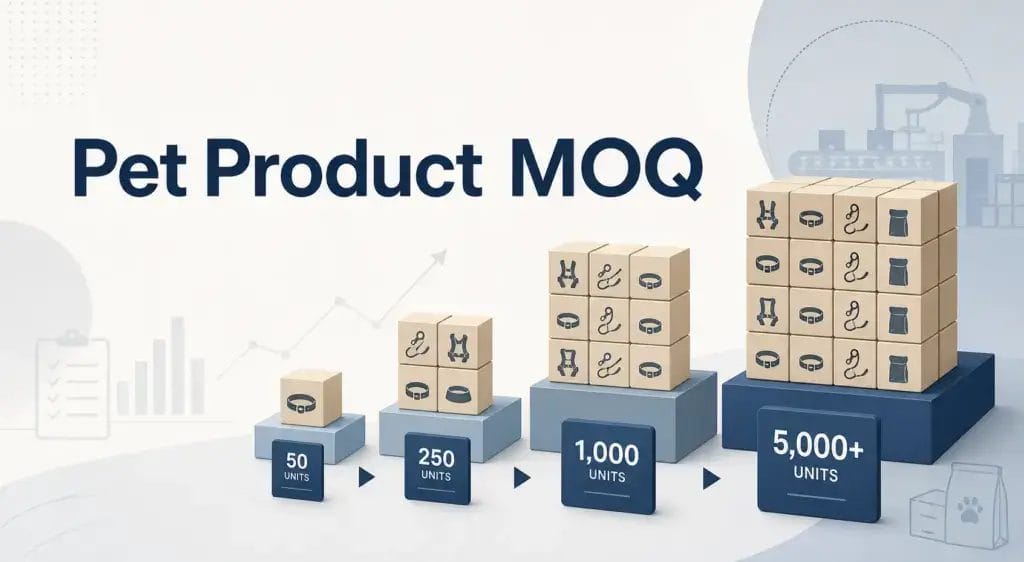
MOQ, or minimum order quantity, is the smallest number of units a factory will produce in a single run. For many first-time buyers, it is also the point where a promising product idea turns into a cash-flow and inventory decision.
In pet product manufacturing MOQ is not an arbitrary barrier. It is the point at which a production run covers its fixed costs — material purchases, tooling, line setup — and stays economical to make. Because those costs vary by product, MOQ varies too. Understanding what drives a given number is what makes it possible to negotiate it down sensibly.
Most buyers meet MOQ as a single figure in a quotation and treat it as fixed. It usually is not. The number reflects specific cost factors, and once those are visible, so are the levers that move it.
For context on where MOQ fits in the full sourcing workflow, our pet product OEM sourcing guide covers manufacturer selection, compliance, and production timelines.
What MOQ means in pet product manufacturing
MOQ is the floor for one production order of one product. A factory quoting an MOQ of 1,000 units will not run 300, because a run that small would not recover what it costs to set up.
One related term is worth knowing: the order multiple. MOQ is sometimes also the increment you must order in. If the MOQ is 1,000 units and the order multiple is also 1,000, every order has to be placed in steps of 1,000 — 1,000, 2,000, 3,000 — not 1,400. This matters because a lower MOQ does not always mean flexible ordering: a factory might agree to start at a smaller first run but still require future orders to move in fixed increments. The two numbers are not always the same, so it is worth asking a factory for both rather than assuming the MOQ alone defines your options.
What actually drives a factory’s MOQ
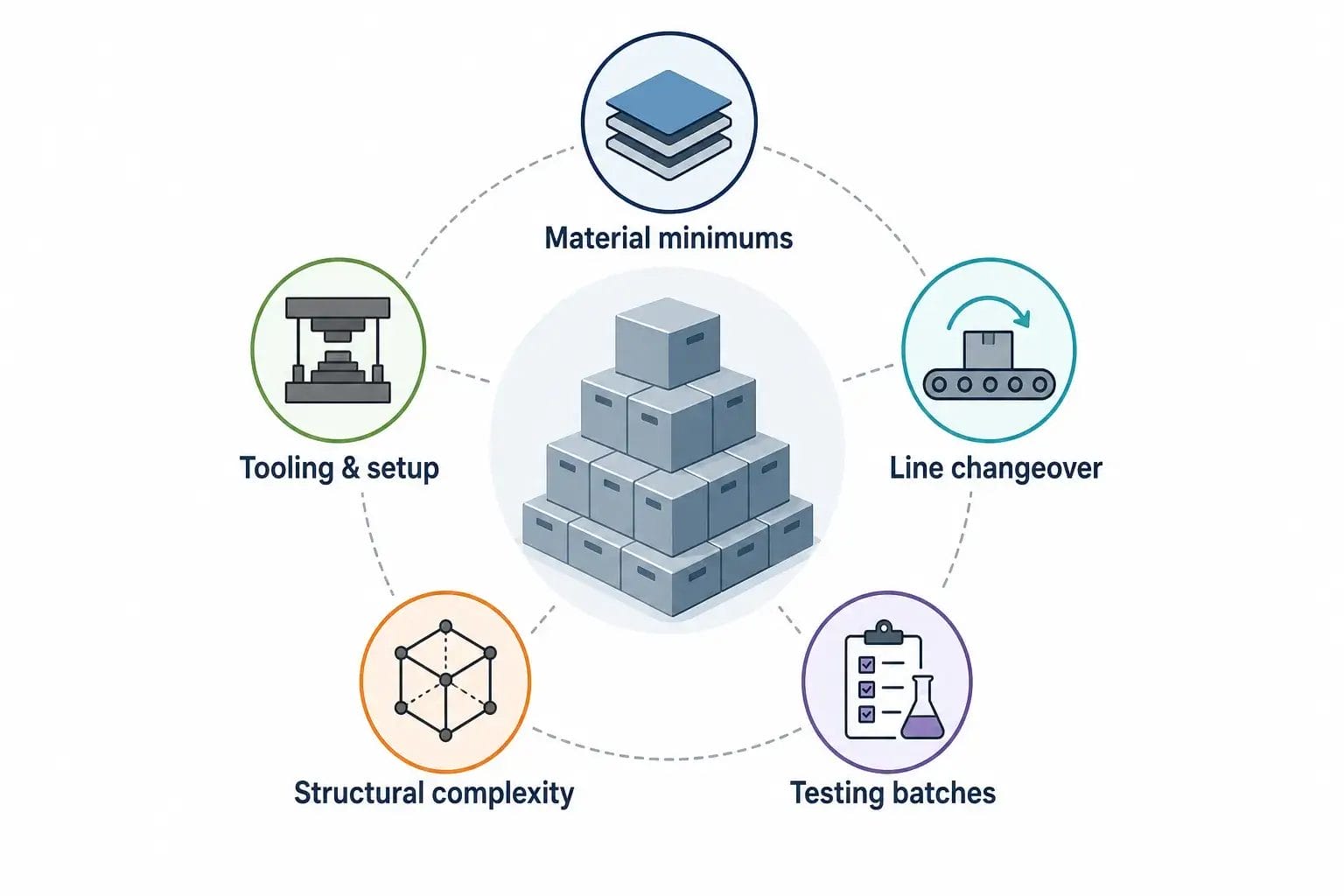
A factory does not pick an MOQ at random. Several real costs sit underneath it, and the highest of them usually sets the floor.
Material minimums are often the largest. Mills and component suppliers have their own MOQs. A specific webbing width, a particular buckle, a custom-dyed fabric color — each may only be sold to the factory in a minimum quantity. If a fabric is sold in 3,000-meter lots and your product needs a meter per unit, that material minimum alone shapes the floor, regardless of how efficient the factory is.
Tooling and setup come next. Custom hardware, a die for a molded part, or a print screen has to be paid for and then justified by a run long enough to spread that cost thinly. The more a product depends on custom tooling, the more pressure there is toward a higher MOQ.
Line changeover is a quieter cost. Putting a product onto a production line means setting up machines, briefing operators, and running trial pieces. That setup time is the same whether the run is 500 units or 5,000, so a short run carries a much heavier setup cost per unit.
Structural complexity ties the others together. A simple flat collar uses few components and little setup. A harness with multiple adjustment points, padding, several hardware pieces, and reinforced stitching pulls in more material minimums and more setup steps — so a more complex product tends to carry a higher MOQ than a simple one from the same factory.
Certification and testing batches can also play a part. Where a market requires testing on production samples, very small runs can make the testing cost per unit hard to absorb.
Why MOQ differs between OEM and ODM
The manufacturing model changes the cost structure underneath MOQ, so the same factory can quote different minimums for OEM and ODM work.
In an ODM project, the base product already exists. Its tooling is built, its materials are already sourced — often in volumes shared across several clients — and its setup is routine. Those costs are already amortized, so the entry quantity is usually easier.
In an OEM project, the product is built to the buyer’s specification. New tooling, newly sourced materials, and a first-time setup all have to be recovered from the buyer’s own order, which tends to push the minimum higher. This is a tendency, not a rule: a heavily customized ODM item can still carry a high MOQ if a requested material, color, or component has its own supplier minimum. The difference between the two models is covered in OEM vs ODM for Pet Products.
The levers that bring MOQ down
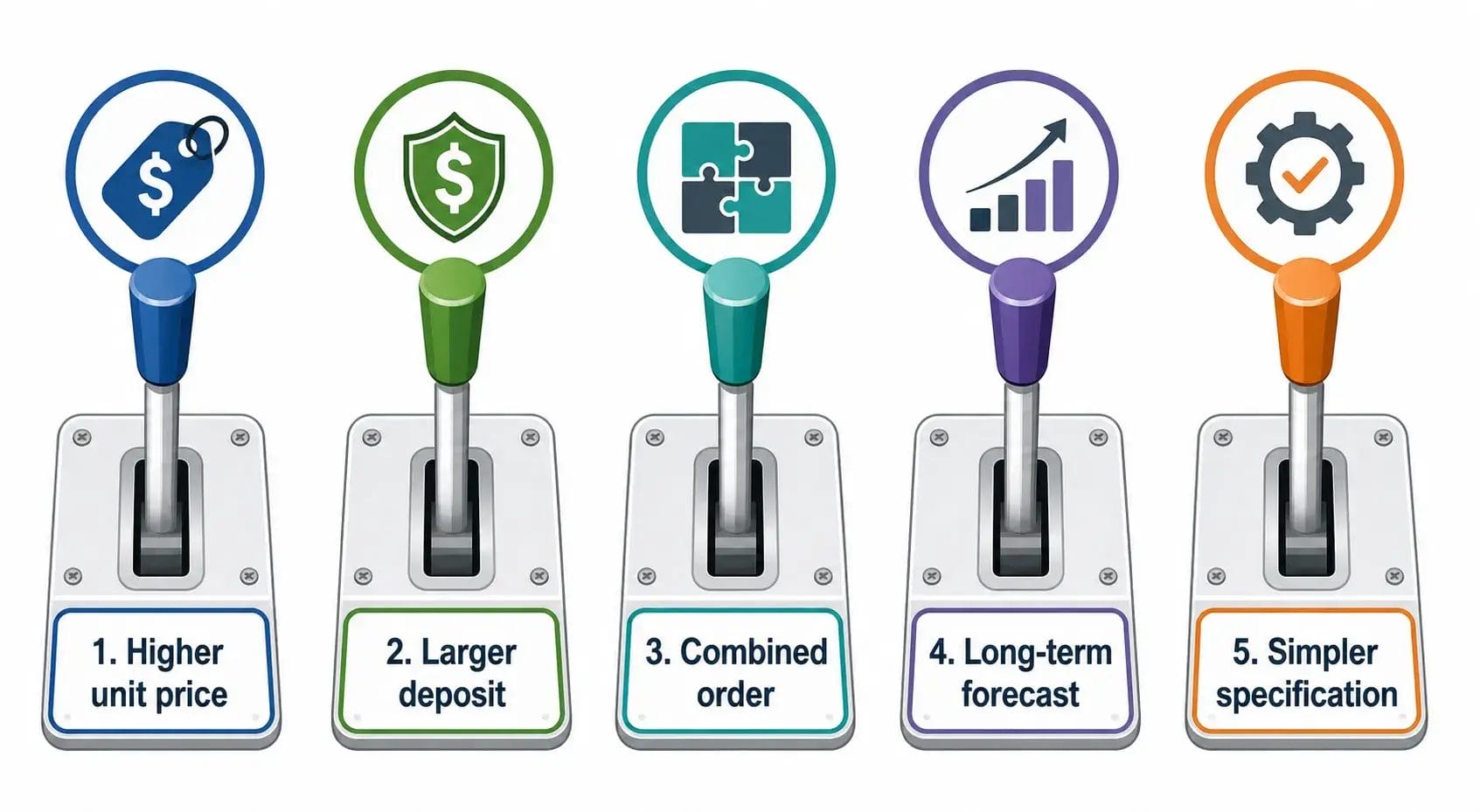
An MOQ in a quotation is a starting point more often than buyers assume. The goal is not simply to ask for a lower number — it is to change the cost or risk equation behind that number. Each lever below works because it helps the factory recover the costs that set the MOQ in the first place, which is also why a reasonable factory will respond to them.
A higher per-unit price for a smaller run. This is the most direct trade. A short run leaves fixed costs spread across fewer units; paying more per unit closes that gap, so the factory is not losing money on a smaller order. Expect a smaller first run to cost more per unit than a full run.
A larger deposit or upfront payment. Fixed costs are spent early — on materials and setup — before anything ships. Covering more of that cost upfront reduces the factory’s exposure and can make a smaller run workable.
Combining products to share a setup. If several of your products use the same base material or the same hardware, ordering them together can meet a material minimum collectively even when no single product would on its own. Asking whether a mix-and-match order is possible is often more productive than pushing one product’s number down in isolation.
A credible long-term commitment. A factory is more flexible on a first run if it can see realistic repeat orders behind it. A forecast or a framework agreement signals that the first order is the start of a partnership, not a one-off, and that the setup cost will be recovered over time.
Simplifying the product or using stocked materials. If a design can use a standard webbing or an existing buckle instead of a custom one, it sidesteps a material minimum entirely. Some MOQ pressure is a design choice, and adjusting the specification early can lower the floor before negotiation even starts.
What to ask before you accept an MOQ
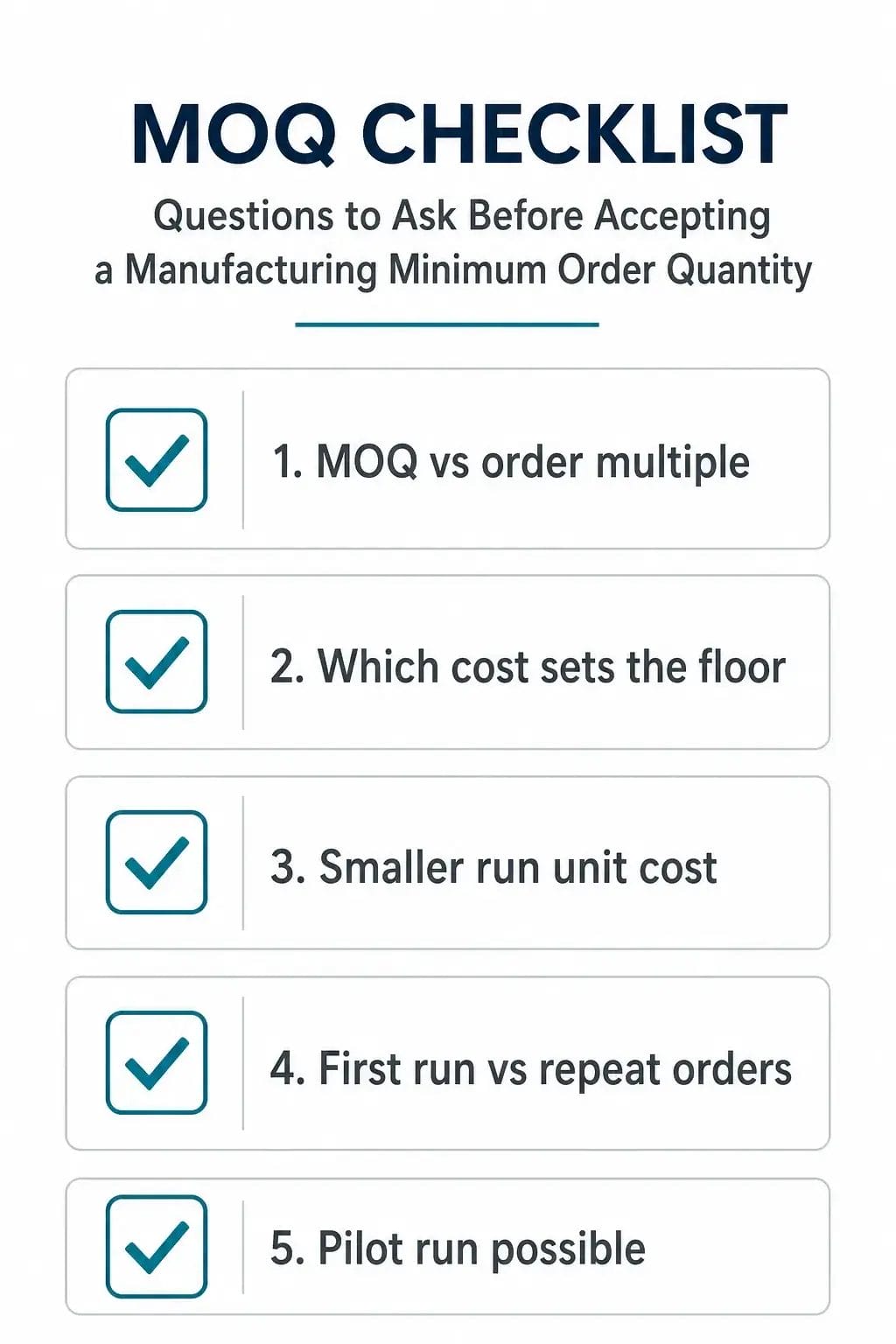
Before treating an MOQ as final, a few questions tend to surface room that the headline number hides:
- Is this the MOQ, the order multiple, or both? Knowing whether you can order in flexible amounts or only in fixed increments changes your planning.
- Which cost is setting this floor — material, tooling, or setup? The answer tells you which lever to pull. A material-driven MOQ responds to shared or stocked materials; a setup-driven one responds to price or combined orders.
- What does a smaller first run cost per unit? This turns “we can’t go lower” into a concrete trade you can evaluate.
- Can the first production run be separated from repeat-order MOQs? Some factories will accept a smaller launch run on the understanding that future orders follow the standard MOQ once demand is validated.
- Is a sample or small pilot run possible before the full order? Some factories will run a limited pilot, separate from the production MOQ, to validate a product before a brand commits.
A factory that explains where its MOQ comes from is giving you something to work with. One that only repeats the number is harder to plan around — and how to tell a sourcing partner from an order-taker is covered in How to Choose a Pet Product OEM Manufacturer.
How MOQ fits your launch plan
A low MOQ is not automatically the right MOQ. The number that suits a launch is the one that balances unit cost against the cash and risk of holding stock.
Push the MOQ too high and capital sits in inventory, storage fills, and an unproven product becomes an expensive bet. Push it too low and the per-unit cost climbs, which thins the margin on every sale. The cheapest unit price can still be the most expensive decision if the product moves slowly and capital stays locked in stock. The useful question is not “how low can this go” but “how many units can I realistically sell before reordering” — and then choosing an MOQ that fits that answer. For a first product with unproven demand, the best first order is often not the absolute lowest quantity, but the smallest run that still validates demand, protects margin, and keeps the factory’s process stable.
CrazyPaws develops pet products across categories including pet harnesses and leashes and collars, where MOQ is often shaped by webbing, hardware, padding, stitching, and packaging choices. For a planned first order, the development team can review the product concept, target market, and preferred quantity to identify what is setting the MOQ — and whether a smaller launch run is technically and commercially workable.
FAQ
What does MOQ mean in pet product manufacturing?
MOQ is the smallest number of units a factory will produce in one run. It exists so a production order covers its fixed costs — materials, tooling, and setup — and stays economical to make.
What is a typical MOQ for pet products?
There is no single reliable figure across all pet products. A simple collar, a padded harness, and a customized leash can all carry different MOQs because their materials, hardware, and setup requirements are different.
Why is the MOQ higher for a new product?
A new product usually needs newly sourced materials, custom tooling, and a first-time line setup. Those fixed costs are recovered from that first order, which pushes the minimum up compared with a product already in production.
Can I combine several products to meet an MOQ?
Often yes. If your products share a base material or hardware, ordering them together can meet a supplier’s material minimum collectively. It is worth asking a factory whether a mix-and-match order is possible.
Does offering a higher price actually lower the MOQ?
It can. A short run spreads fixed costs across fewer units; a higher per-unit price helps the factory cover those costs, so a smaller run no longer loses money. It is one of the most direct ways to negotiate a lower minimum.
Is MOQ negotiable for a first order?
Often yes, but usually through trade-offs rather than a straight reduction. A factory may lower the first-order MOQ if the buyer accepts a higher unit price, uses stocked materials, combines products, or provides a credible repeat-order plan.
How do I find a manufacturer that accepts lower MOQs?
Look for a factory that explains what drives its MOQ rather than only stating a number, that can discuss price, deposit, or combined-order options, and whose typical run sizes match your order rather than dwarfing it.
Related product categories
Pet Harness OEM
Pet Leash & Collar OEM
Further reading
OEM vs ODM for Pet Products
How to Choose a Pet Product OEM Manufacturer
The Pet Product Manufacturing Timeline: From Prototype to Mass Production