

CA65, REACH, and RoHS are often listed together as the chemical compliance standards a pet product has to meet, but they do not cover the same ground. CA65 is a California warning law, REACH is a broad EU chemical regulation, and RoHS is an EU directive that applies only to electrical and electronic equipment. For most pet products, the first two are relevant and the third is not. The key is not collecting all three documents — it is matching the right regulation to the product and the market. Getting that match wrong is the difference between a compliance file that holds up and one that looks complete but is not.
For the full sourcing context that compliance fits within, our pet product OEM sourcing guide covers the end-to-end process from manufacturer selection through production.
Why these three regulations get grouped together — and why that’s misleading
All three restrict hazardous substances, and all three are things a buyer hears about early when sourcing from overseas. That shared purpose is why they end up in the same sentence on supplier websites and in sourcing checklists.
The grouping is misleading because the three differ on every axis that matters: which jurisdiction they belong to, which products they cover, and how a product demonstrates compliance. Treating them as one combined “chemical safety” requirement leads to the most common sourcing mistakes — paying for the wrong test, accepting a document that does not apply to the product, or assuming one certificate covers every market.
| Regulation | Jurisdiction | Product scope | How compliance is usually shown |
|---|---|---|---|
| CA65 / Proposition 65 | California | Products sold in California that may expose users to listed chemicals | Warning analysis, a warning label, or category-specific limits, depending on the chemical and product |
| REACH | EU | Broad — chemicals in articles and materials generally | Material review, SVHC declaration, test reports, and supply-chain documentation |
| RoHS | EU | Electrical and electronic equipment only | RoHS test report or declaration for the equipment and its components |
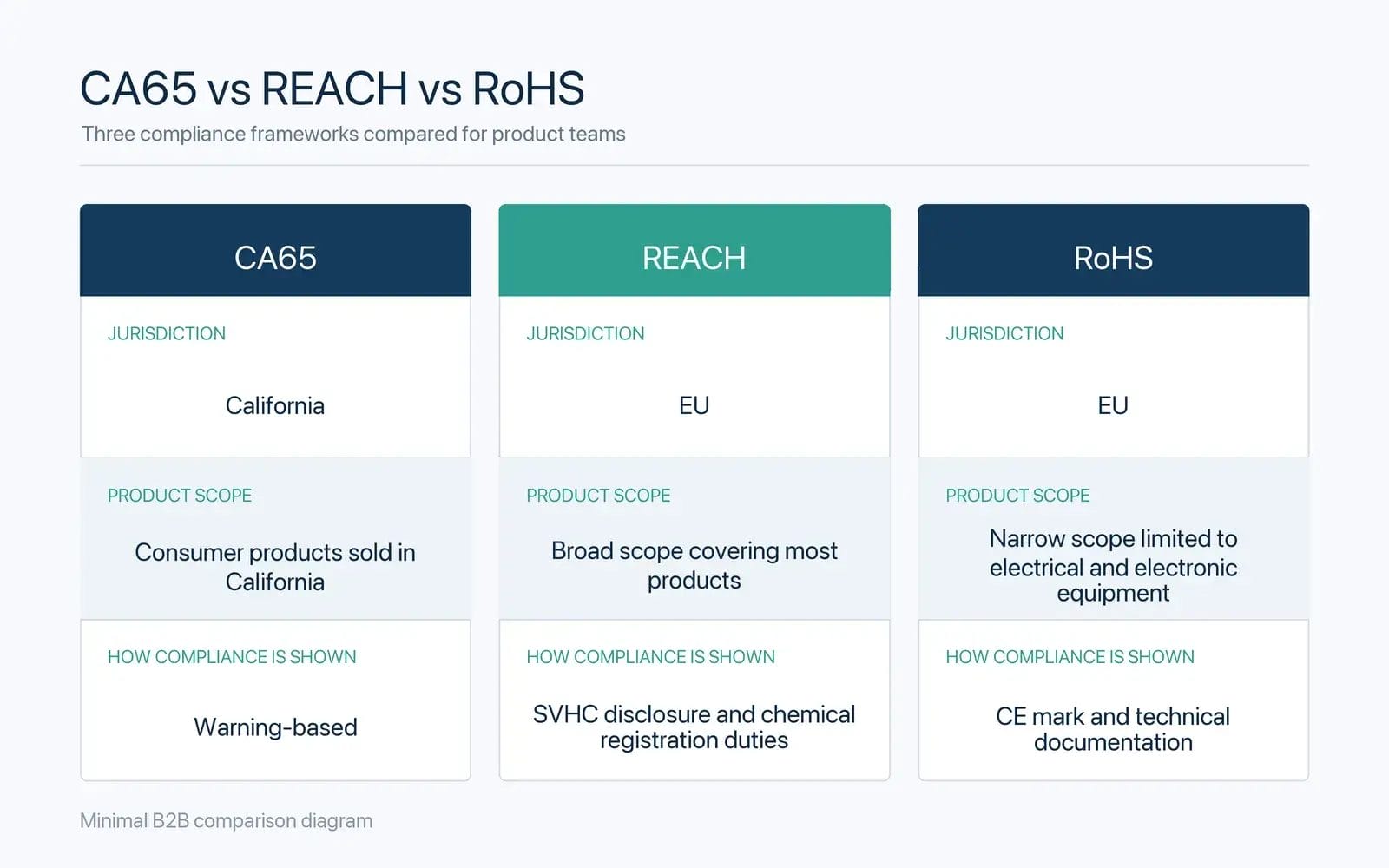
The rest of this article takes them one at a time.
CA65 (Proposition 65): a California warning law, not a ban
Proposition 65 — formally the Safe Drinking Water and Toxic Enforcement Act of 1986, and commonly written CA65 — is a California law. It requires a business to provide a warning when a product sold in California exposes people to a chemical on the state’s list. California publishes that list and updates it at least once a year; it has grown to around 900 chemicals known to the state to cause cancer, birth defects, or other reproductive harm.

The first thing to understand is what CA65 does not do. It does not ban anything. A product can contain a listed chemical and still be sold in California, provided the required warning is given. For pet products, the chemicals that come up in practice are a narrower set than the full list — lead and the phthalates DEHP and DINP appear repeatedly in pet product enforcement cases, showing up in plastics, coatings, and synthetic materials.
There is a detail here that buyers regularly miss. For some pet product categories, a warning label is not an accepted alternative to meeting a concentration limit. Enforcement settlements involving items such as pet accessories, pet carriers, and pet coats have set actual limits — for example, capping a phthalate at a defined parts-per-million level — where the product has to meet the limit rather than simply carry a warning. So “we added the CA65 warning” does not by itself mean the product is compliant. Whether a warning is enough, or a hard limit applies, has to be checked per product category and chemical — it is not something to assume.
REACH: the EU’s broad chemical regulation
REACH is the European Union’s regulation on chemical substances, and its scope is wide. It is not limited to any one product type — it covers chemicals in articles generally, which in practice means almost every physical product placed on the EU market.
For pet products, that breadth is the point. The webbing and fabric in a harness, the plastic in a buckle or a bowl, the coating on a metal clip, the dyes in a printed collar — all of these fall within what REACH addresses. In sourcing practice, buyers most often encounter REACH through SVHC declarations and test reports, since the list of Substances of Very High Concern (SVHCs) is the most visible part of the documentation. But REACH itself is broader than a single SVHC checklist — it also covers substance restrictions, registration, and communication obligations along the supply chain. PFAS chemicals have been a significant focus of recent SVHC additions, and PFAS can appear in water-repellent treatments used on outdoor pet gear.
Because the SVHC list moves, a REACH file is not a one-time, permanent document — it reflects the list as it stood when the testing was done. For a buyer, the useful question is not just whether a supplier has a REACH document, but whether it covers the current material set and the current Candidate List.
For a buyer selling soft-goods pet products in Europe, REACH is the regulation that genuinely applies. This also connects to how compliance responsibility is shared along the supply chain, which differs depending on the difference between OEM and ODM and which party owns the material decisions.
RoHS: electrical and electronic equipment only
RoHS is the regulation most often misapplied to pet products, so it is worth being precise. RoHS is an EU directive that restricts certain hazardous substances in electrical and electronic equipment — EEE. Its scope is narrow. If a product has no electrical or electronic function, RoHS does not apply to it.
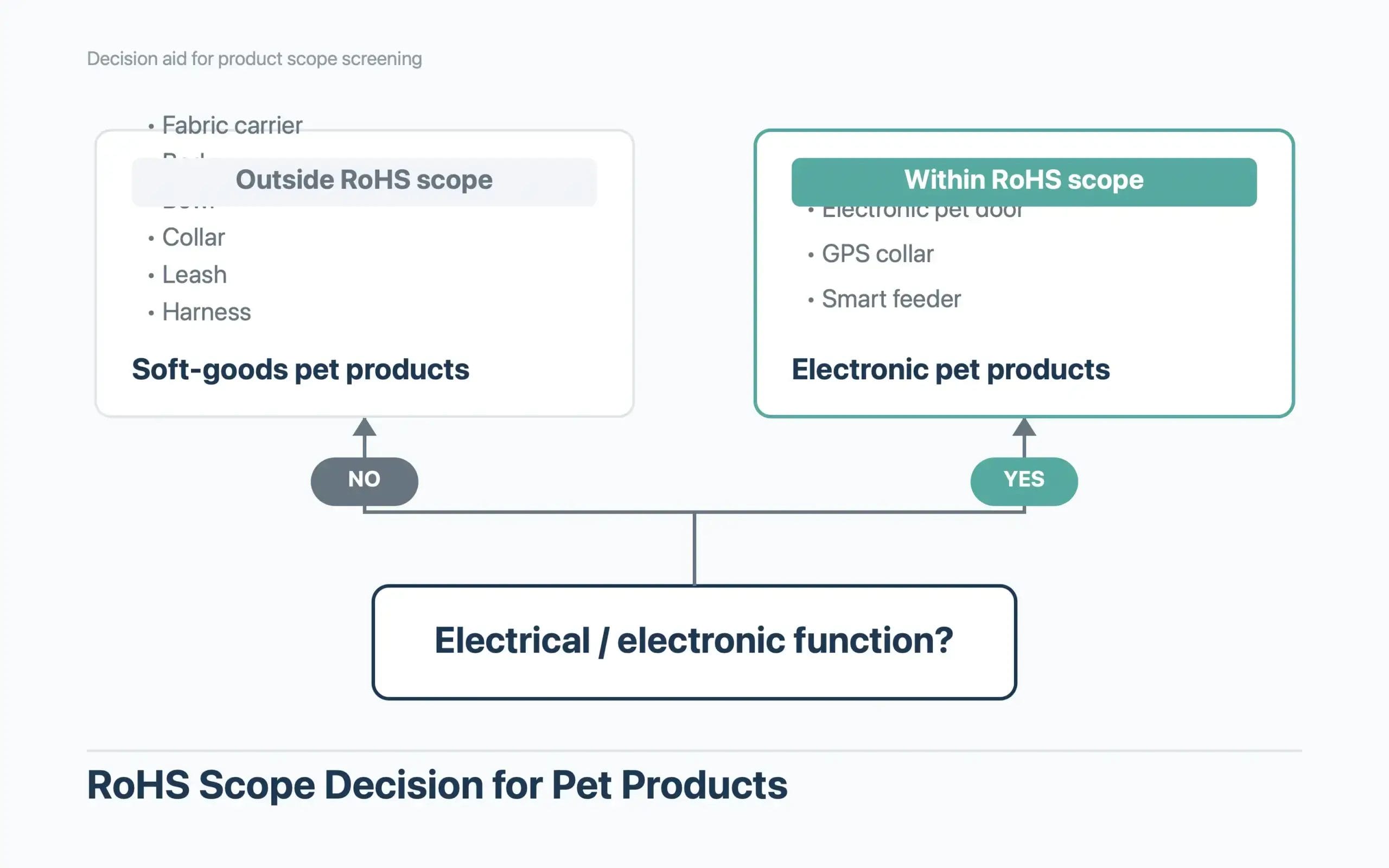
Most pet products are not electronic. A harness, a leash, a collar, a feeding bowl, a bed, a fabric carrier — none of these are EEE, and none of them need RoHS testing. This leads to a practical warning sign. If a supplier presents a RoHS test report for a non-electrical pet product, that report does not demonstrate anything useful: the product is not within RoHS scope, so the document would not hold up under scrutiny by authorities. RoHS testing a few materials is inexpensive, and a RoHS certificate can give a false sense that a non-electronic product has been checked for chemical safety when the relevant regulation for that product is actually REACH. Put plainly: a RoHS report is not a general chemical safety certificate for all of a product’s materials.
RoHS does apply when a pet product genuinely has an electrical or electronic function — a smart feeder, a GPS tracking collar, an electronic pet door, an automatic laser toy. For those products, RoHS is real and necessary, and it sits alongside REACH rather than replacing it, since REACH applies to the chemicals throughout the product as well.
Three common compliance misconceptions
A few recurring misunderstandings are worth naming directly, because each one produces a compliance file that looks finished but is not.
For the full sourcing context that compliance fits within, our pet product OEM sourcing guide covers the end-to-end process from manufacturer selection through production.
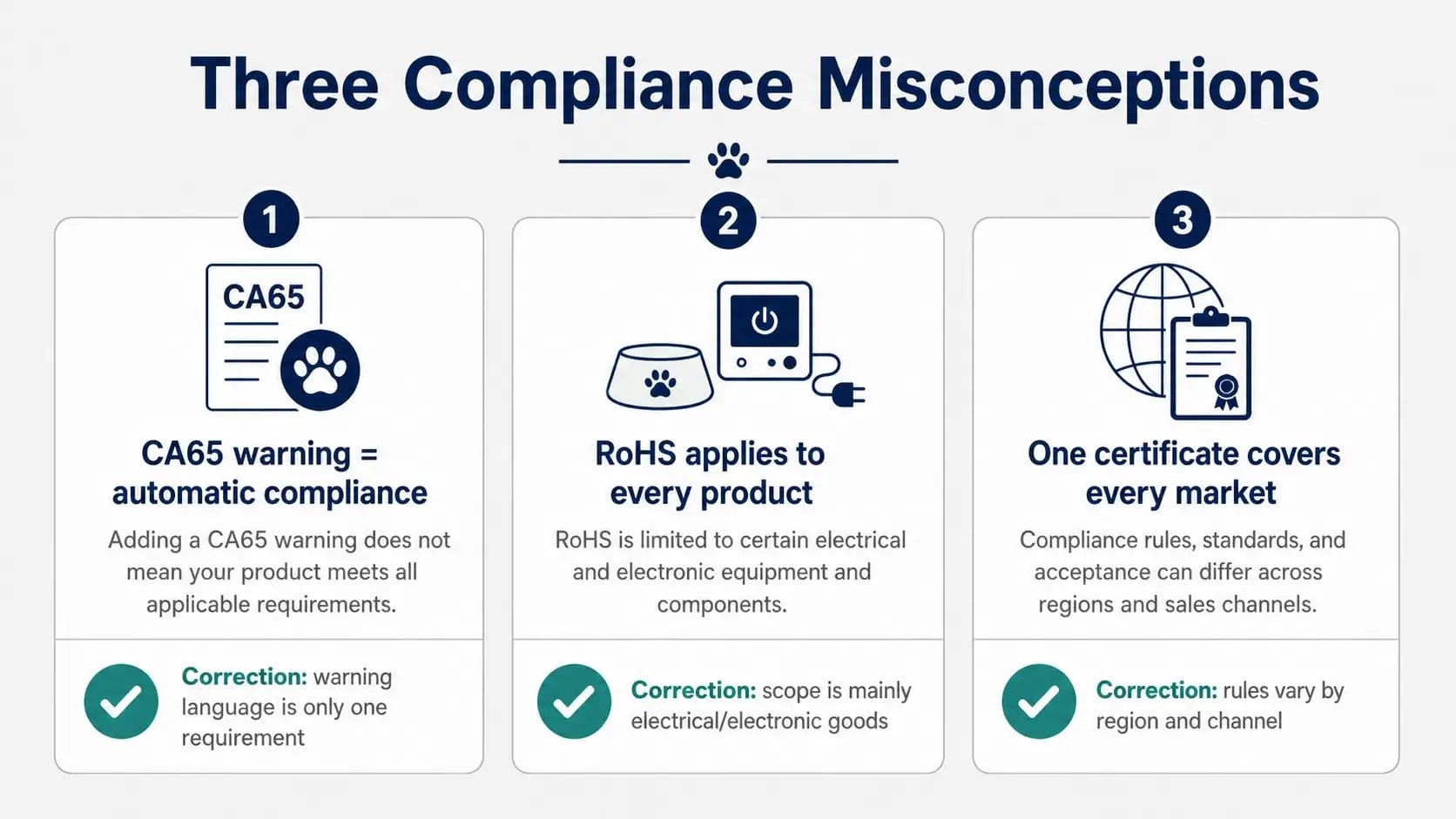
The first is treating a CA65 warning as automatic compliance. As above, some pet categories require a chemical to stay under a limit, and a warning label does not substitute for that. The second is applying RoHS to non-electronic products, or accepting a RoHS report as proof of chemical safety for a soft-goods item — the product is outside RoHS scope, and REACH is the regulation that should have been considered. The third is the “one certificate covers everything” assumption. CA65, REACH, and RoHS differ in geography, in product scope, and in how compliance is shown; a document prepared for one does not carry over to another. A buyer selling the same harness in California and in Germany is looking at two different regulatory pictures, not one.
What this means for sourcing: matching the regulation to the product and market
The workable approach is to start from two questions: what is the product made of, and where is it going to be sold. The materials determine which chemicals are plausibly present, and the destination market determines which regulation governs them. A soft-goods product bound for the EU points to REACH; the same product sold into California points to CA65; an electronic pet product adds RoHS to the EU picture.
That turns into a short set of checks before accepting any compliance file. Confirm where the product is sold — California, the EU, or both — since that decides which regulations are even in play. Confirm whether it has an electrical or electronic function, which decides whether RoHS belongs in the picture at all. Then check that each report actually matches the product’s materials rather than being a generic certificate, that any REACH or SVHC documentation reflects the current Candidate List, and that the CA65 position is clear about whether it rests on a warning, a limit, or both.
This is also where a manufacturer’s role matters. A factory that can explain which regulation applies to your specific product, and can provide test documentation that matches the product rather than a generic certificate, is doing compliance work properly — a point covered in how to choose a pet product OEM manufacturer. For the market-by-market view of how these requirements line up across regions, see how compliance differs across the US, EU, and Japan. A fuller treatment of export compliance as a whole is covered in Pet Product Export Compliance: A Complete Guide for Brands and Importers.
This article describes how these regulations are generally structured for sourcing discussions. It is not legal advice. Chemical lists, concentration limits, enforcement positions, and official guidance can change over time, so specific requirements should always be checked against the current official sources for each regulation.
FAQ
Does CA65 ban pet products that contain listed chemicals?
No. CA65 is a warning law, not a ban. A product containing a listed chemical can still be sold in California if the required warning is provided — though for some pet categories, a chemical must stay under a set limit and a warning is not an accepted substitute.
Do pet harnesses, leashes, and collars need RoHS testing?
No. RoHS applies only to electrical and electronic equipment. Harnesses, leashes, collars, and other soft-goods pet products have no electronic function and fall outside RoHS scope. REACH is the EU regulation relevant to those products.
Which regulation covers the fabric and plastic in a pet product?
REACH. It covers chemical substances in articles broadly, including the webbing, fabric, plastic, coatings, and dyes used in pet products sold in the EU.
Can a warning label replace chemical testing under CA65?
Not always. For some pet product categories, enforcement settlements have set concentration limits that the product must meet, and a warning label is not an accepted alternative. Whether a warning is sufficient depends on the product category and chemical.
When does a pet product actually need RoHS compliance?
When it has a genuine electronic component — a smart feeder, GPS collar, electronic pet door, or automatic toy. For those products, RoHS applies alongside REACH, not instead of it.
How can I tell if a manufacturer’s compliance documents match my product?
Check that the test report covers the actual product type and the regulation that applies to it. A RoHS report for a non-electronic product, or a generic certificate not tied to your materials, is a sign the documentation has not been done properly.
To discuss which chemical compliance requirements apply to a specific pet product, you can talk it through with the CrazyPaws team.