
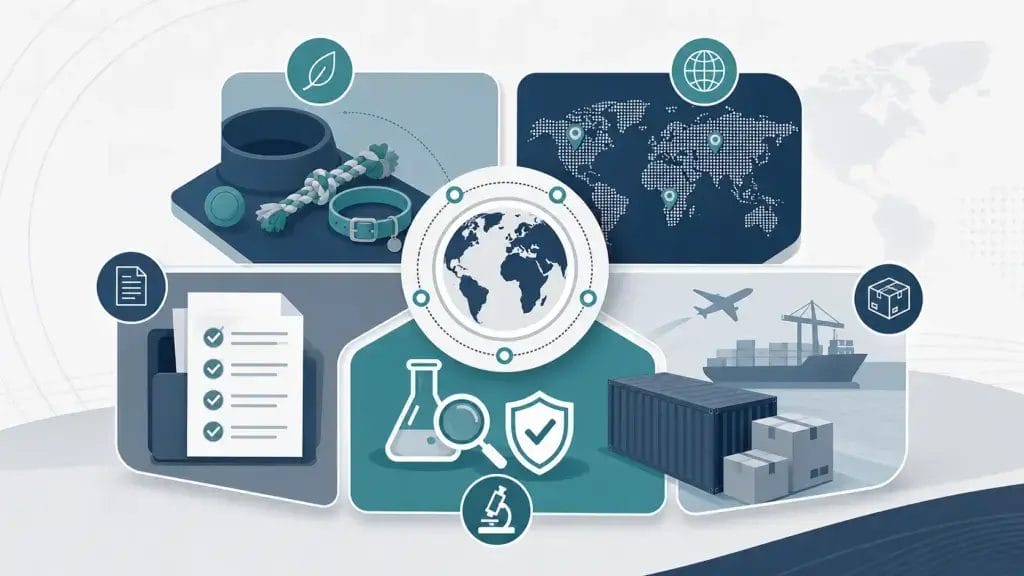
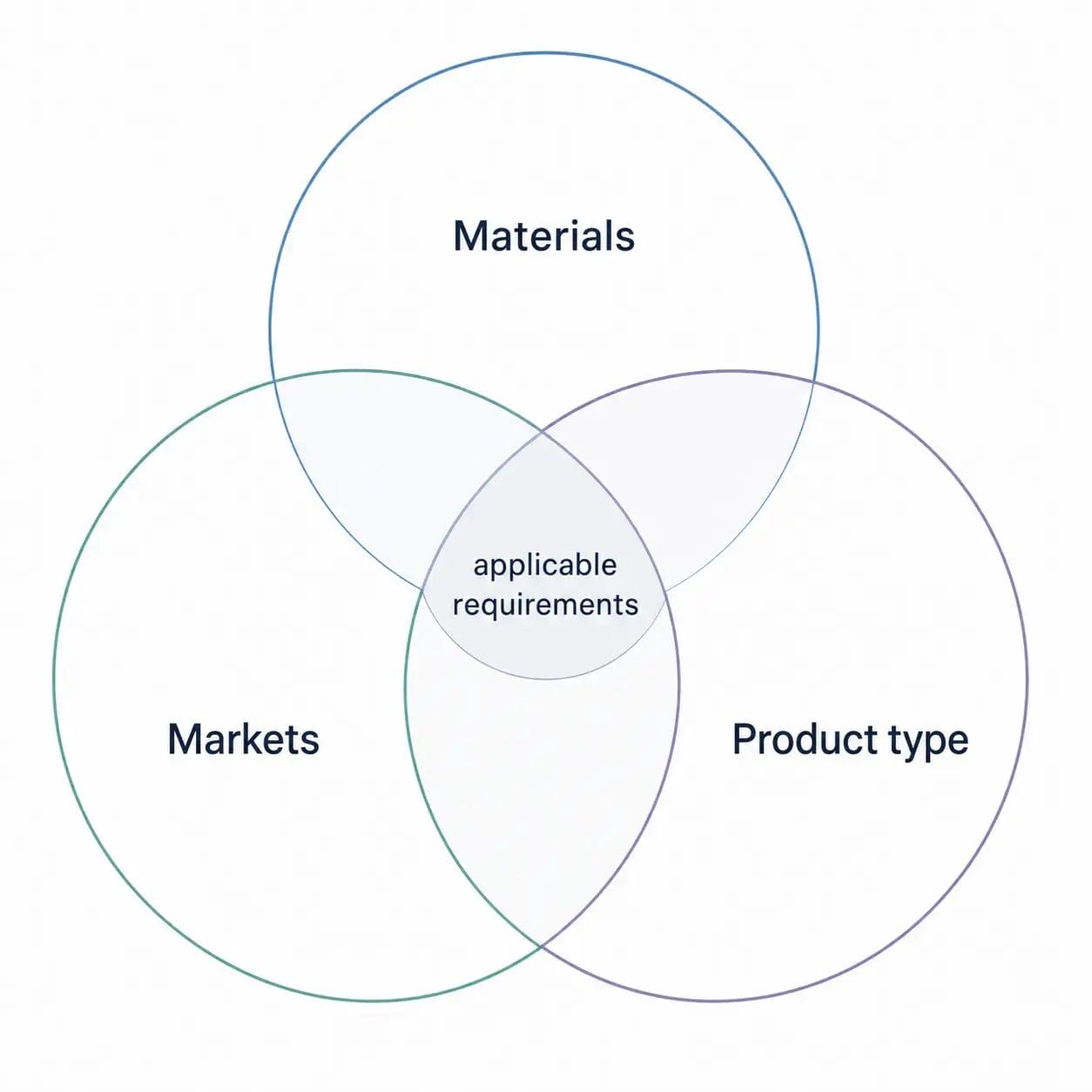
Most of the trouble brands run into with pet product compliance comes from treating it as a single thing — one certificate, one test, one box to tick. It is not. Compliance for an exported pet product is a set of requirements that fall out of three things together: what the product is made of, which markets it sells into, and what type of product it is. A fabric harness sold in California, the EU, and Japan does not face one rule; it faces different obligations in each, and those obligations are driven by its materials more than its name. This guide lays out how the pieces fit — the markets, the chemical regulations, the sustainability claims, and who along the supply chain is responsible for each — and points to the detailed articles on each piece.
The good news for most brands is that pet products, being non-food consumer goods, are generally regulated as ordinary consumer products rather than under a special pet-specific regime. That keeps the framework manageable. The work is in mapping the right requirements to the right product.
What “compliance” actually means for pet products
The instinct to look for “the certificate” is the first thing worth unlearning. There is rarely a single document that makes a pet product compliant everywhere. A test report that satisfies one market may be irrelevant in another; a certificate that covers one material says nothing about a different component in the same product.
What compliance actually is, in practice, is a match. You take the product — its materials, its construction, its function — and you map it against the rules of each market it will sell in. The output is a short list of obligations specific to that product in that market: which chemicals are restricted, what has to be tested, whether anything has to be labeled, and what documentation proves it. Get the match right and the file holds up under scrutiny. Get it wrong — pay for the wrong test, accept a document that does not apply — and the file looks complete while leaving the brand exposed. The useful question to start from is not “which certificate do I need” but “which obligations attach to this material in this market.”
The five questions that make up that match, and where each is answered in detail, look like this:
| Compliance question | What it depends on | Common mistake | Go deeper |
|---|---|---|---|
| Which market rules apply? | The target sales market | Assuming one market’s clearance carries to another | Compliance by market |
| Which chemical rules apply? | Materials and product function | Treating CA65, REACH, and RoHS as one requirement | CA65, REACH, and RoHS |
| Can we claim recycled content? | Certified recycled inputs and chain of custody | Treating sustainability copy as pure marketing | GRS Certified Recycled Materials in Pet Product Manufacturing: What Brands Need to Know |
| Who holds responsibility? | The OEM or ODM model and who owns the design | Assuming the other party handled it | OEM vs ODM |
| Does the documentation match? | The actual product, facility, and materials | Accepting a generic certificate | Choosing a manufacturer |
The rest of this guide walks each row in turn.
Compliance follows the material, not the product name
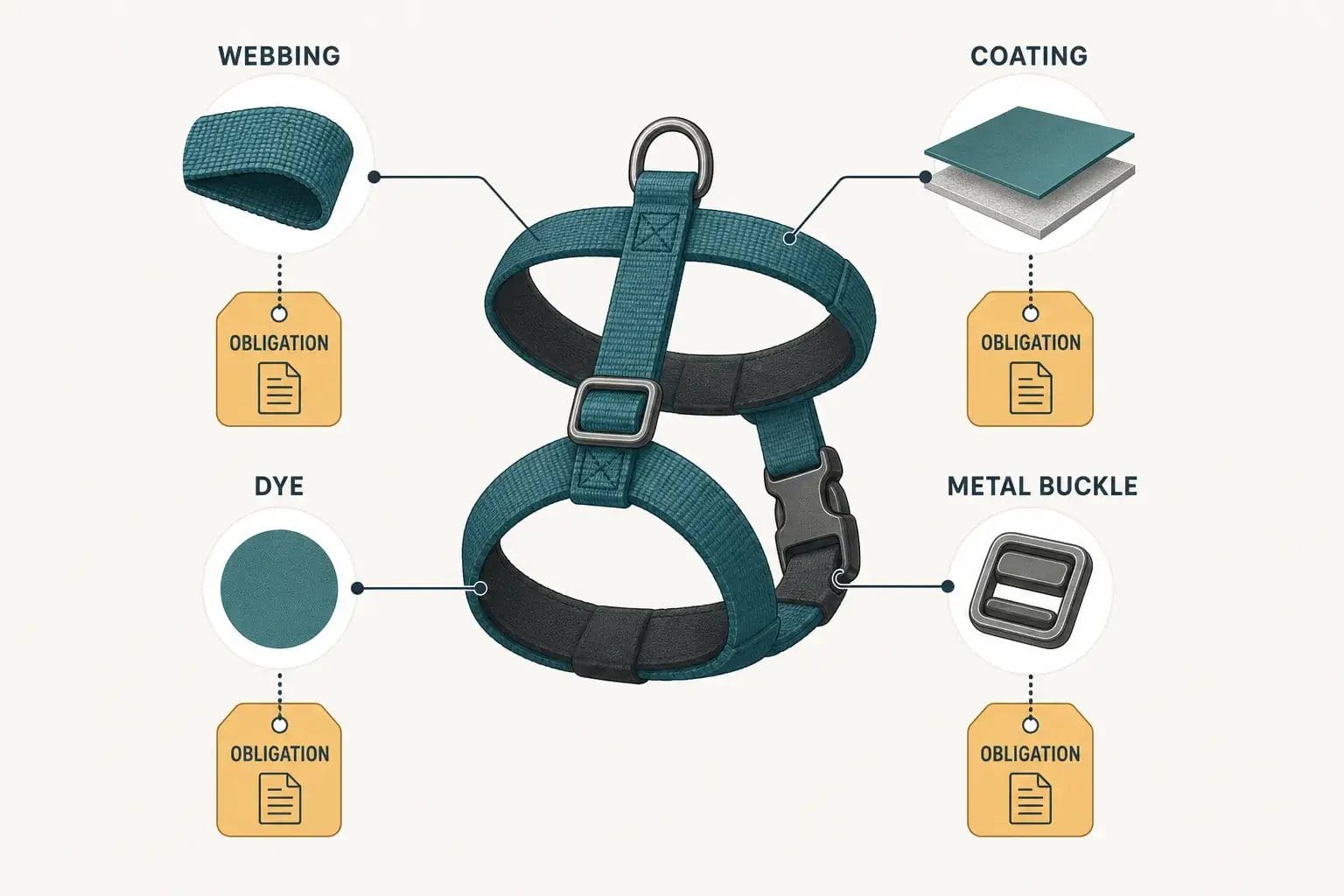
This is the single idea that makes the rest of the picture coherent. What a pet product has to comply with is determined by what it is made of, not by what the category is called.
Take a dog harness. Whether it needs anything done about chemical limits depends on its webbing, its coatings, its dyes, and the metal in its buckles — not on the word “harness.” Two harnesses on the same shelf can carry completely different obligations because one uses a PVC-coated fabric and the other a plain woven nylon. The same logic runs through every soft pet product: the textile, the plastic, the coating, and the hardware each bring their own potential restrictions. A brand that starts from materials, rather than from the product label, ends up testing the right things and skipping the irrelevant ones.
This is also why a credible manufacturer asks about materials early. The material specification is where compliance is decided, long before a test report is ordered. It is the thread connecting everything below — the market rules, the chemical regulations, and the sustainability claims all attach to materials.
For a soft-goods pet product, the compliance review usually has to account for each of these:
- Main fabric or webbing
- Coatings and laminations
- Dyes, prints, and surface treatments
- Plastic parts and trims
- Metal hardware
- Packaging and any labeling claims
Each line can carry its own restriction in a given market, which is why a single “the product is compliant” statement rarely means much without knowing what was actually checked.
The cost of leaving compliance to the end
When compliance goes wrong, the root cause is usually timing rather than ignorance. A brand designs the product, sources the materials, approves the samples, and only then — often when a retailer or customs broker asks for documentation — starts working out what testing it needs. By that point the materials are locked, the tooling is cut, and any obligation that requires a material change is expensive to fix.
The recurring version of this is the late material substitution. A factory swaps a component for a cheaper equivalent during costing, the brand signs off without re-checking the compliance implications, and a coating or plasticizer that was fine in the original spec is now a restricted substance in one of the target markets. Nothing was hidden; the check simply happened too late to matter. The same is true of labeling: a market that requires a warning is far cheaper to accommodate at the artwork stage than after the first run is printed.
Treating compliance as a sampling-stage activity rather than a pre-shipment one changes the economics entirely. Compliance is cheapest when it is settled at material specification, more expensive once samples are approved, and most expensive after production has run. The questions are the same either way — which markets, which materials, which regulations, which documents — but asked early they shape the product, and asked late they threaten it. The workflow at the end of this guide puts them in the order that keeps compliance cheap.
Where your market sets the rules
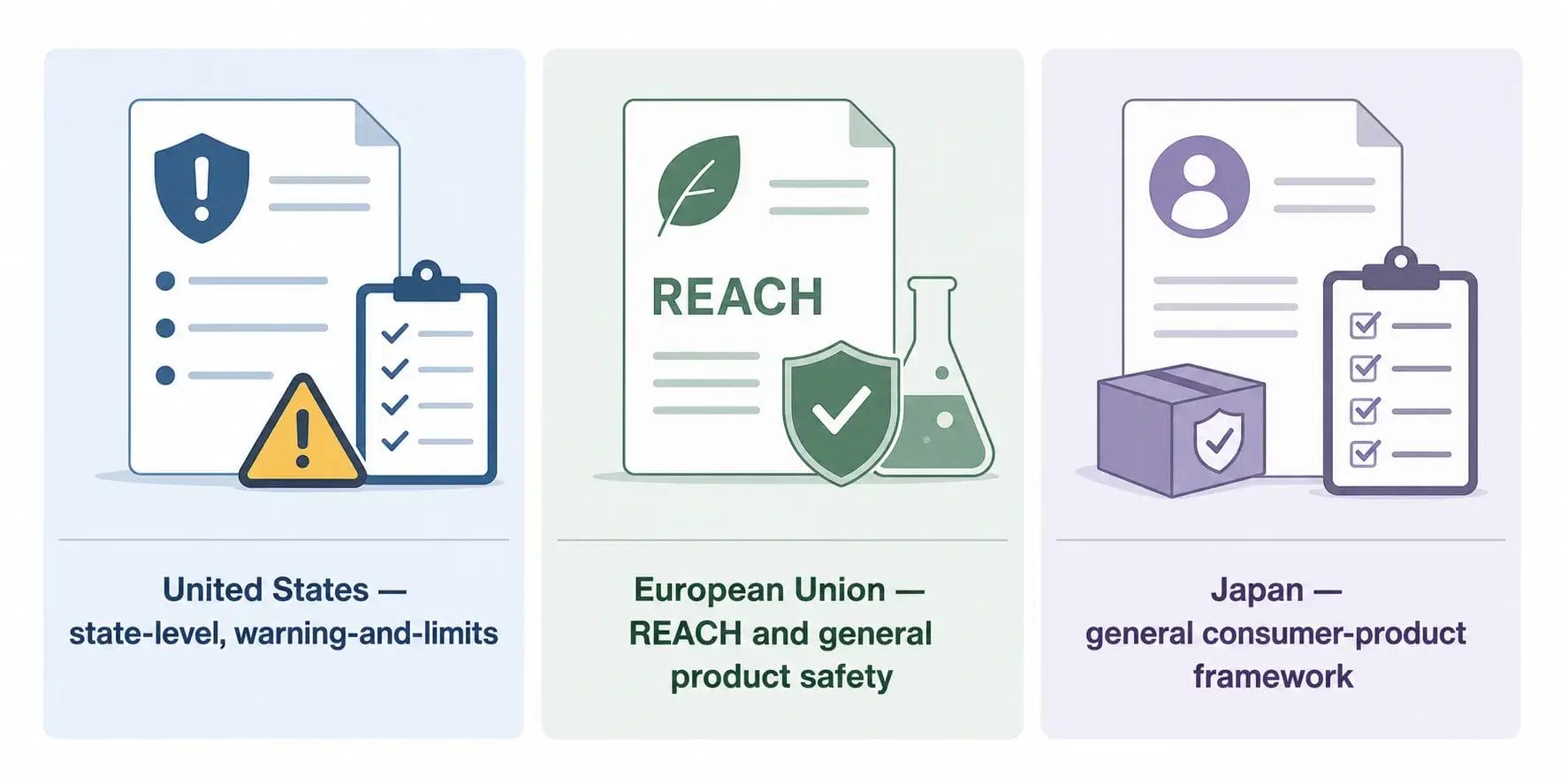
Geography is the first axis. The same product can be perfectly sellable in one market and need a warning label or a different test in another, because each major market regulates consumer goods on its own terms.
In broad strokes: the United States approaches this largely through state-level rules, most prominently California’s Proposition 65, which is a warning-and-limits regime rather than an outright ban. The European Union works through REACH and general product safety rules that apply across nearly all goods. Japan handles pet products under its general consumer-product framework rather than a dedicated pet regime. Those are very different mechanisms, and a product strategy that assumes one market’s clearance carries to the others is the most common way a compliance file falls short. The market-by-market detail — what each one actually requires and a checklist to run before you export — is covered in Pet Product Compliance by Market: US, EU, and Japan.
The chemical regulations behind the labels
Underneath the market rules sit the specific chemical regulations, and these are where the most confusion lives. CA65, REACH, and RoHS get listed together as if they were one requirement, but they belong to different jurisdictions, cover different products, and are demonstrated in different ways. CA65 is a California warning law; REACH is the EU’s broad chemical regulation covering substances in nearly all articles; RoHS is an EU directive that applies only to electrical and electronic equipment — which means most soft pet products fall outside it entirely.
That last point trips up a lot of brands: a RoHS report is not a general chemical safety certificate for a non-electronic soft good. A RoHS report for a harness or bed does not demonstrate anything useful, and it does nothing for the REACH obligations that actually apply to those products. Sorting out which of these regulations attaches to a given product — and which does not — is what the B2 article above covers in detail.
When sustainability claims become compliance
There is a fourth axis that is easy to miss because it looks like marketing rather than regulation: the moment a brand makes a claim about recycled or sustainable materials, that claim becomes something it has to be able to prove. “Made with recycled materials” on a hangtag is, in effect, a compliance statement — and unsubstantiated, it is a greenwashing liability as regulators and retail platforms tighten their scrutiny.
The main mechanism here is the Global Recycled Standard, which verifies recycled content and tracks it through the supply chain with chain-of-custody documents. It is also in the middle of a transition to a new framework, the Materials Matter Standard, on a timeline that runs through 2027 — which matters for any product line planned to last. The general rule is that the more specific the sustainability claim, the more specific the proof has to be. How GRS works, what the content thresholds are, and how the transition affects sourcing now is what the B3 article above covers.
Who is responsible for what across the supply chain
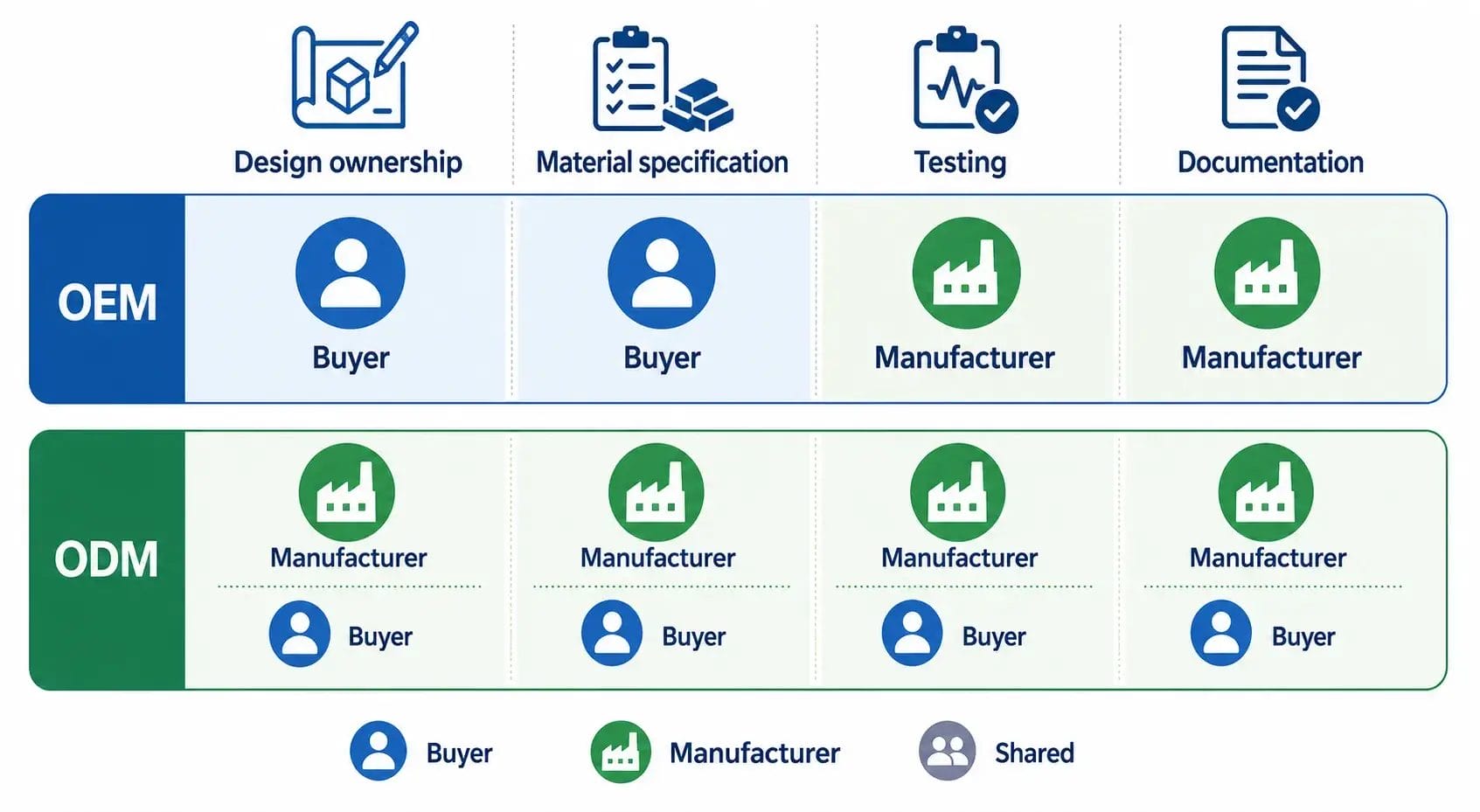
Compliance obligations do not all sit in one place, and where they sit depends partly on how the product is made. Under an OEM arrangement, where the brand owns the design and specifies the materials, the brand carries more of the responsibility for deciding what has to be tested and for holding the documentation. Under an ODM arrangement, where the factory supplies an existing design, more of that groundwork may already exist — but the brand still has to confirm it covers the materials and markets in question. The distinction between the two models, and what each implies for who owns what, is laid out in the A1 article linked above.
Roughly, the split falls out like this:
| Task | Brand | Manufacturer |
|---|---|---|
| Define target markets | Leads | Supports |
| Specify materials | Leads under OEM; confirms under ODM | Supports under OEM; leads under ODM |
| Arrange testing | Confirms what is required | Provides samples and reports |
| Hold documentation | Leads | Provides source documents |
| Confirm scope matches the product | Leads | Provides facility and material scope |
The practical risk is the gap in the middle: a brand assuming the factory handles compliance, and a factory assuming the brand specified what it needed. Closing that gap is a conversation to have before sampling, not after a shipment is questioned. The brand does not have to run the tests itself, but it does have to know which tests apply and confirm the supplier can produce documents that match the actual product — not a generic certificate filed under the company name.
A pre-export compliance workflow
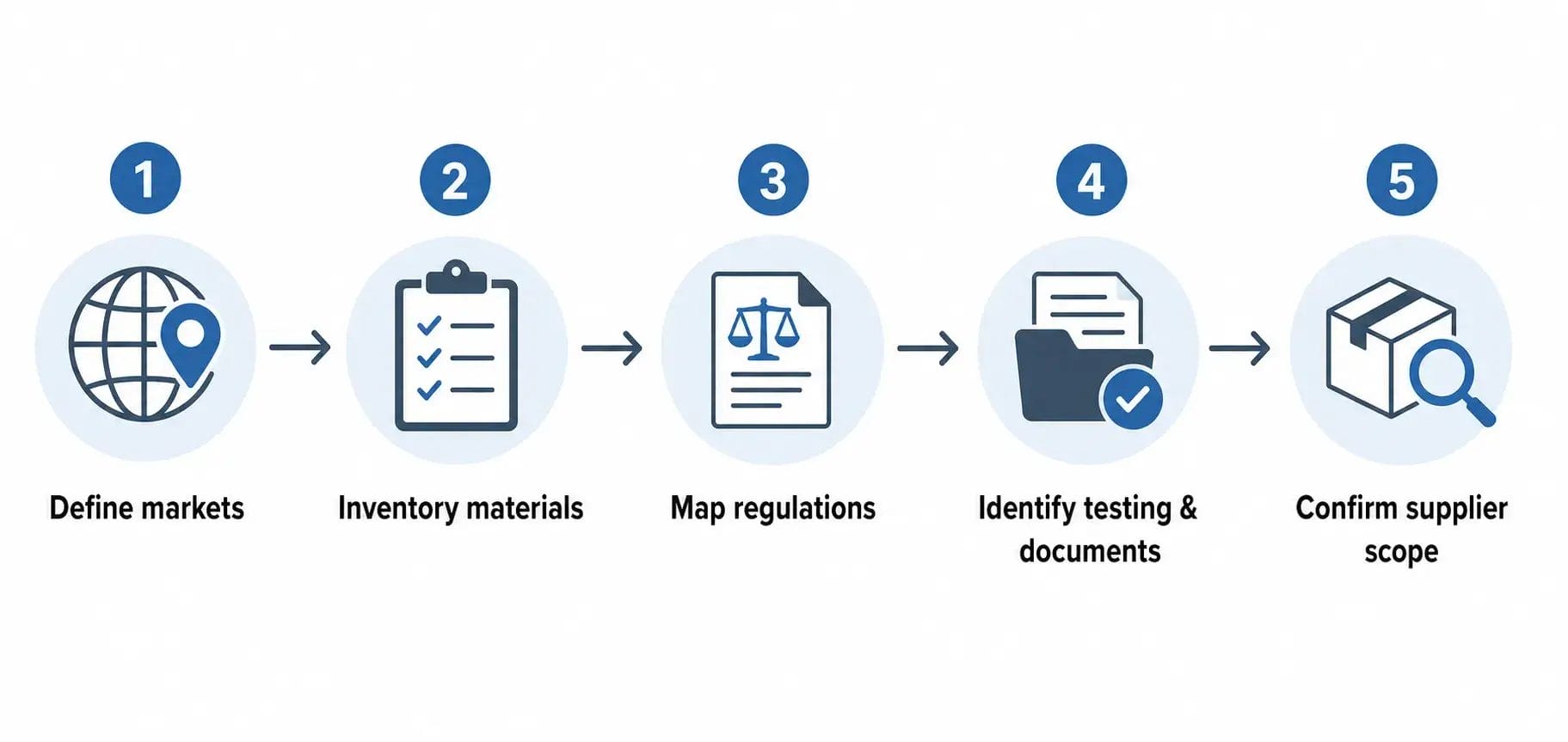
The five axes above come together as a sequence. Starting with certificates reverses the order — a certificate is the output of the mapping process, not its input. Rather than starting from “which certificate do I need,” a brand gets a cleaner result working in this order:
- Define the target markets first, since they set which rule systems apply at all.
- Inventory the materials — every textile, plastic, coating, dye, and metal component — because the materials decide the obligations.
- Map the applicable regulations to those materials and markets, separating what genuinely applies from what does not.
- Identify the testing and documentation each obligation requires, and confirm the test reports cover the actual product, not a related one.
- Confirm the supplier’s certification scope reaches the specific facility and materials your order uses, and that it can issue documents tied to your product.
That last step is where sourcing and compliance meet. A manufacturer that classifies the category clearly, asks about materials and markets before quoting, and can produce documentation matching your specific product is a very different partner from one that hands over a generic certificate. How to tell them apart, and what red flags to watch for when vetting a factory’s compliance claims, is covered in How to Choose a Pet Product OEM Manufacturer.
None of this is legal advice, and the specific limits and lists referenced across these regulations are updated regularly — the official sources are the authority on current requirements. The point of the workflow is not to memorize the rules but to ask the right questions in the right order, so that compliance is built into the product from the material specification onward rather than bolted on before shipment.
If you are working through the requirements for a specific pet product, the CrazyPaws team can help map which obligations apply to your materials and target markets, and confirm how the documentation will support your claims. The materials that drive most of these obligations show up across the soft-goods categories — webbing and coatings in pet harnesses and leashes and collars, fabrics and hardware in pet carry systems, and food-contact plastics in pet feeding products — so the compliance conversation is most productive once the product category and its materials are on the table.
FAQ
Which certifications does a pet product need to be exported?
There is no single answer — it depends on the product’s materials and the markets it sells into. A soft fabric product sold in the EU faces REACH obligations; the same product sold in California may face Proposition 65; an electronic pet product adds RoHS. The first step is mapping materials and markets, not picking a certificate.
Is compliance the brand’s responsibility or the factory’s?
Both, but the split depends on the model. Under OEM, the brand owns the design and carries more responsibility for specifying what gets tested and holding the documentation. The factory runs production and supplies test reports, but the brand has to confirm those reports cover the actual product and markets.
Can one certificate cover multiple markets?
Usually not. The US, EU, and Japan use different regulatory mechanisms, so a document satisfying one often says nothing about another. Some test data can support claims in more than one market, but a single blanket certificate covering everything is a warning sign rather than reassurance.
How are pet products regulated in the US, EU, and Japan?
Generally as ordinary non-food consumer goods rather than under a pet-specific regime. The US leans on state rules like California’s Proposition 65; the EU uses REACH and general product safety rules; Japan applies its general consumer-product framework. The mechanisms differ enough that each market needs its own check.
Do recycled-material claims need certification?
If you put a recycled claim on a product, you need to be able to substantiate it. Certification such as GRS provides the traceability and documentation that retailers and regulators increasingly expect. An unverified recycled claim is difficult to defend and carries greenwashing risk.
How do I confirm a manufacturer’s compliance documents match my product?
Check that each test report covers the actual product type and the regulation that applies to it, and that any certification scope reaches the specific facility and materials your order uses. A report for the wrong product type, or a generic certificate not tied to your materials, means the documentation has not been done properly.