
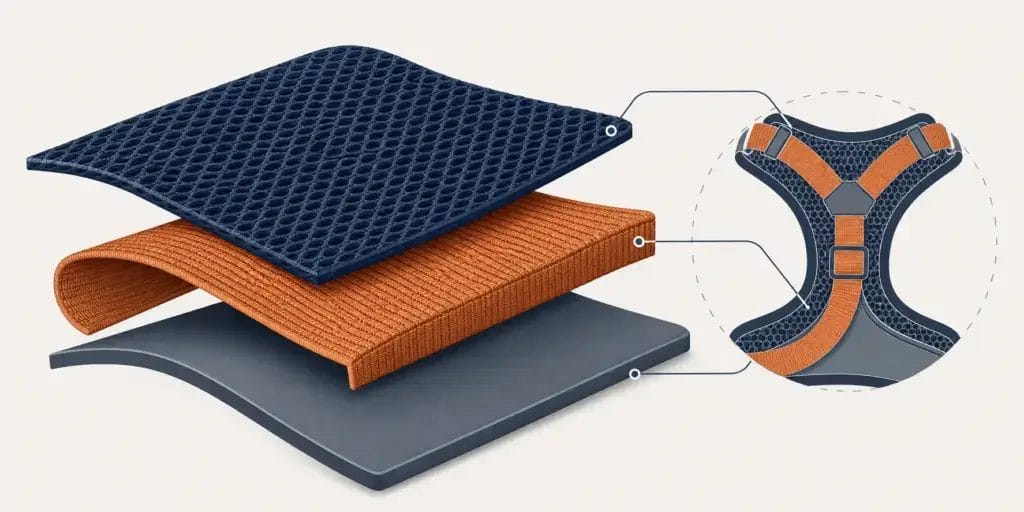
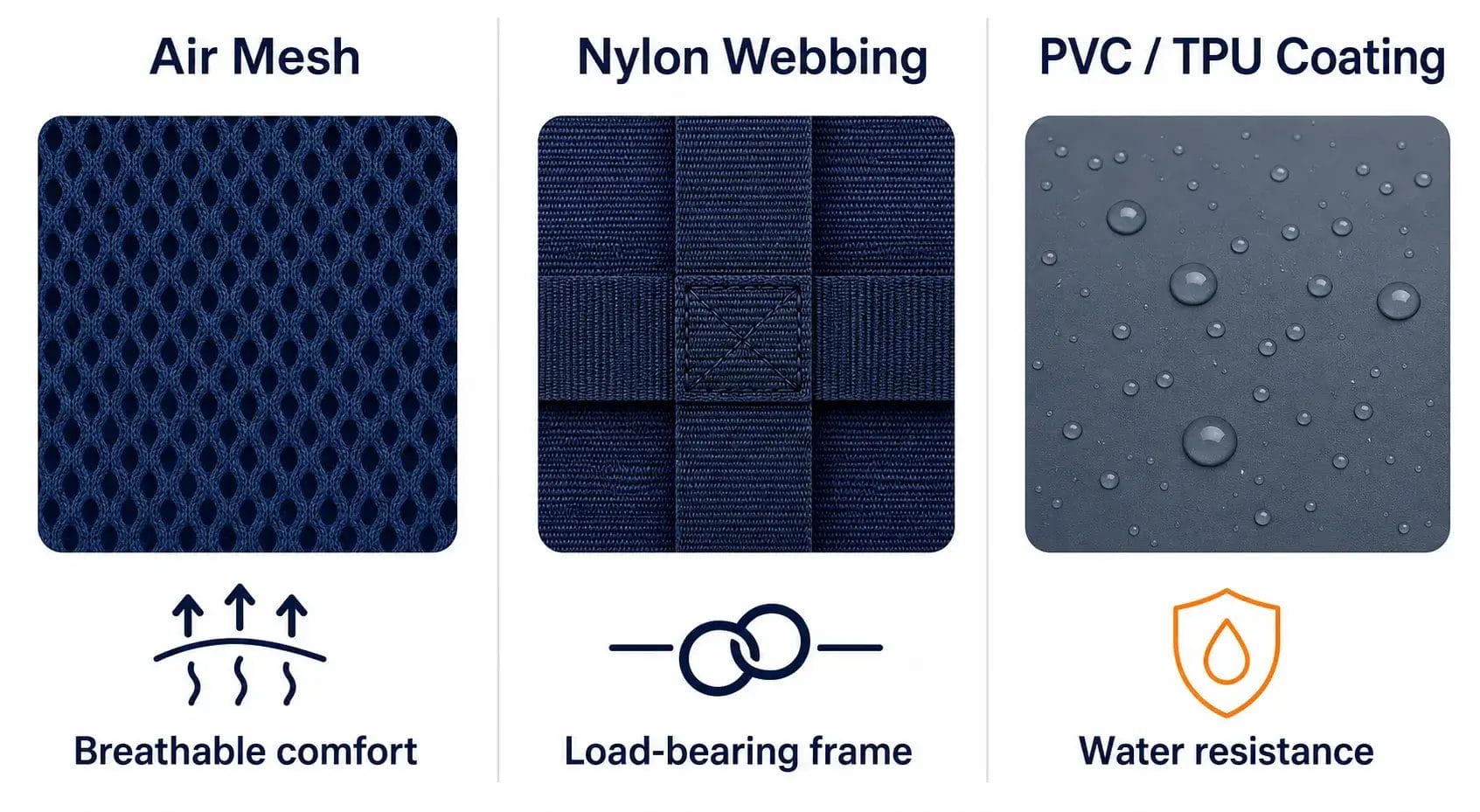
A dog harness is rarely made from a single material. Air mesh provides breathability and a soft layer against the body, nylon webbing carries the structural load, and a PVC or TPU coating adds water resistance and easy cleaning. Most harnesses combine these by function — webbing where strength is needed, mesh where airflow matters, coating where the product has to shrug off water. The right question, then, is not which material is best overall, but which material should do which job in the harness — and that follows from the product’s positioning, use case, and target market.
Why dog harness material is rarely a single choice
It is tempting to ask “what is the best material for a dog harness” and expect one answer. In practice, the question does not have one, because a harness has to do several things at once that no single material does well.
It has to hold tension without stretching out of shape. It has to sit against an animal’s body without chafing. It often has to survive rain, mud, and repeated cleaning. A material that excels at one of these tends to be mediocre at another — strong webbing is not breathable, breathable mesh is not load-bearing, a waterproof coating does neither job structurally. So the realistic way to think about harness materials is by role: which material forms the structure, which one sits against the dog, and which one handles the elements.
| Material | Best role in a harness | Strengths | Watch-outs |
|---|---|---|---|
| Air mesh | Chest and back comfort panels | Breathable, soft, light, slight padded feel | Not load-bearing; quality varies by thickness and backing |
| Nylon webbing | Structural straps and D-ring anchor points | Strong, flexible, handles load well | Edge finishing matters; a poor cut edge can abrade fur |
| PVC / TPU coating | Water-resistant coated webbing | Easy to clean, water-resistant, odor-resistant | Check coating chemistry, base webbing, and target-market compliance |
The sections below take the three most common materials in that light.
Air mesh: breathability and next-to-body comfort
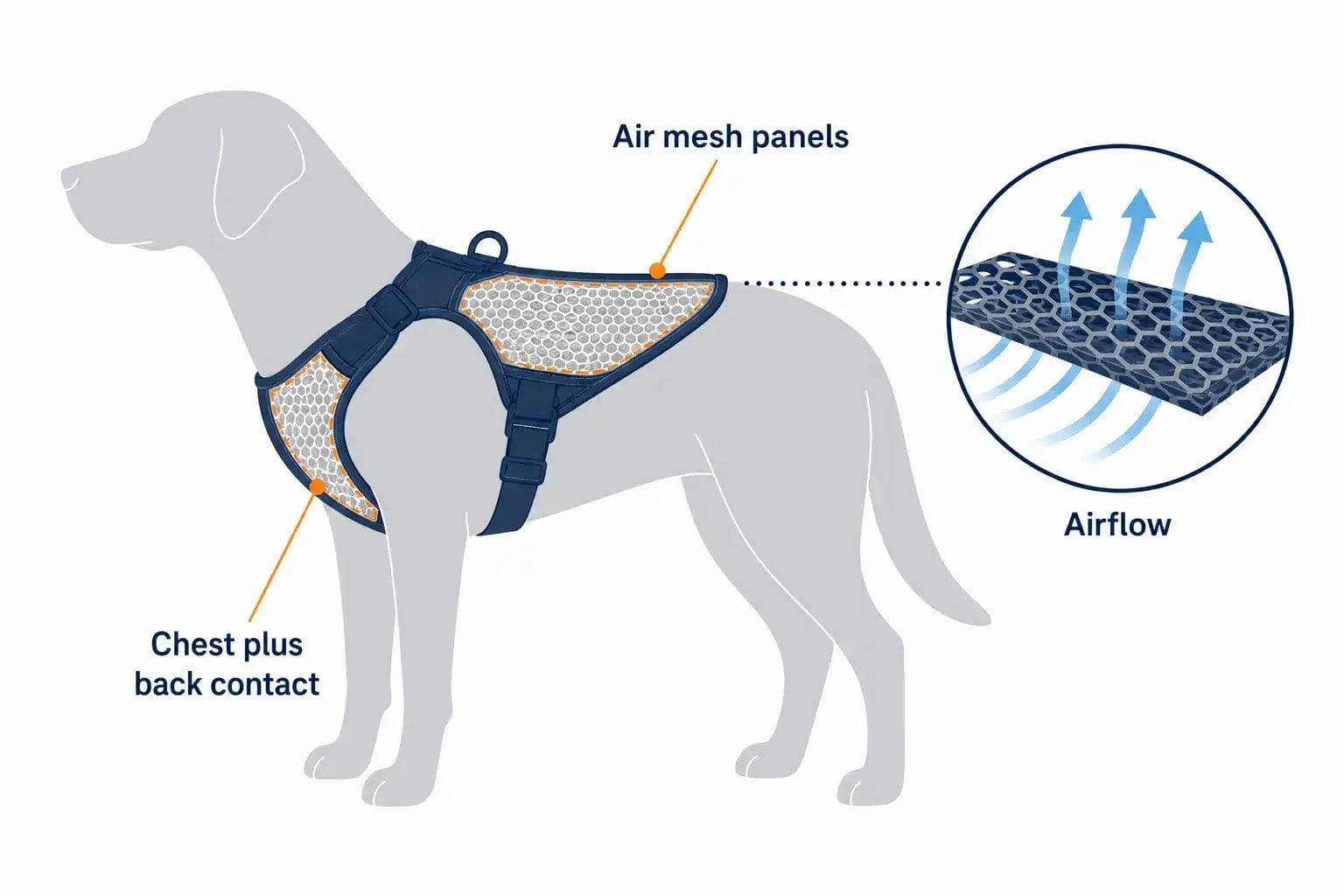
Air mesh is a knitted fabric with an open, three-dimensional structure that lets air move through it. On a harness, its job is comfort and ventilation. It is light, it has a slight built-in padding effect, and it breathes well, which makes it the material of choice for the panels that contact the dog directly.
This suits certain products more than others. Vest-style harnesses for small and medium dogs lean heavily on air mesh, and so do harnesses aimed at warm or humid climates, where heat retention is a real complaint. What air mesh does not provide is tensile strength. It is not a load-bearing material, and a strong puller will deform or damage a harness that relies on mesh for structure. That is why, in a well-designed harness, air mesh appears as a panel or a lining — not as the part taking the pulling force.
One sourcing point: “air mesh” is a material type, not a single fixed spec. The actual feel depends on mesh weight, thickness, hole size, and whether it is laminated to foam or another backing fabric — all of which affect cost and comfort. It should be specified by those properties, not treated as one standard fabric.
Nylon webbing: the structural backbone
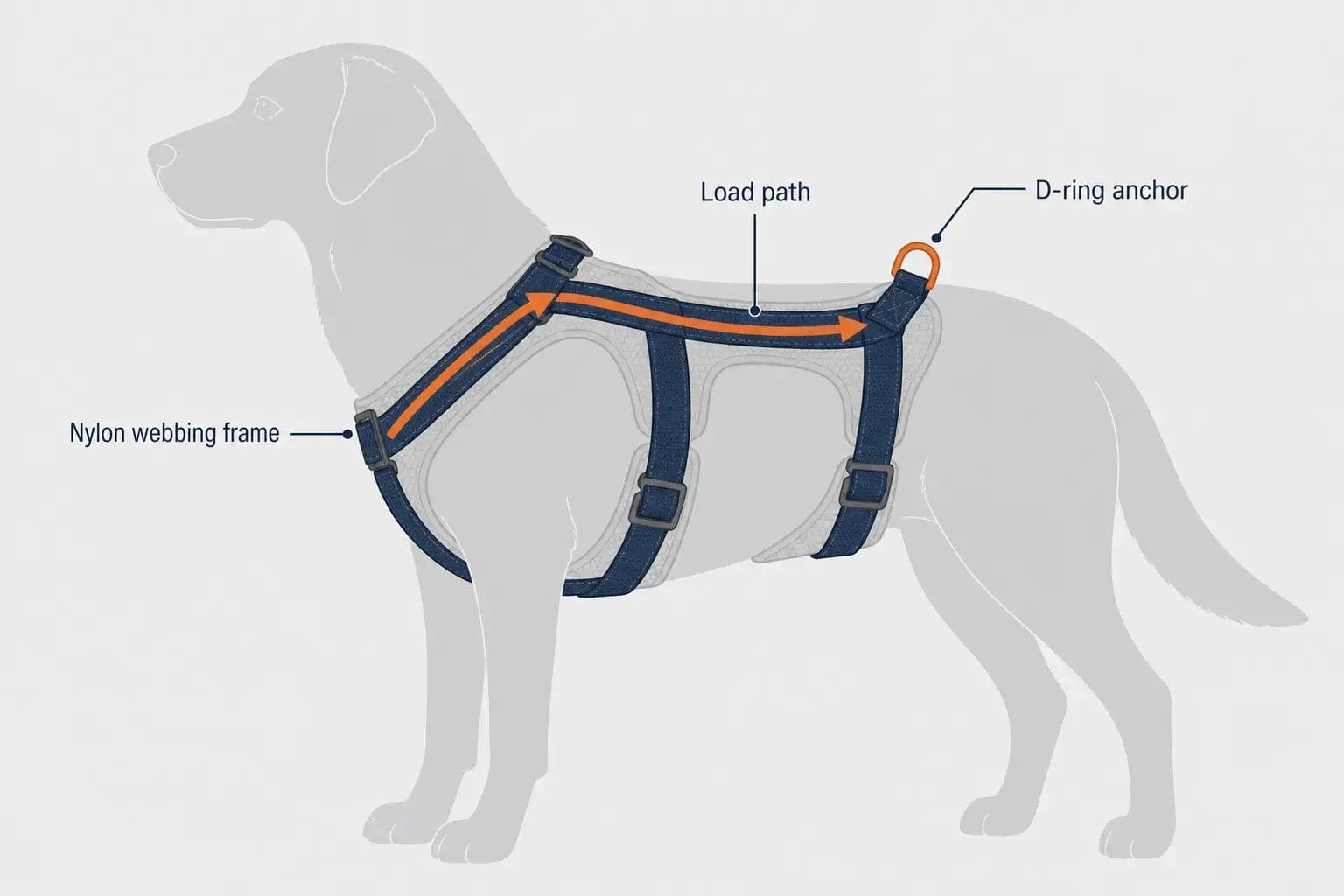
Nylon webbing is what actually holds a harness together under load. It has high tensile strength, it resists tearing, and it keeps a degree of flexibility under tension rather than going brittle. In most harnesses, the straps that wrap the chest and shoulders and anchor the D-ring are nylon webbing, regardless of what the comfort panels are made of.
Nylon is often compared with polyester webbing, and the two are genuinely different. In many harness applications, nylon is preferred where flexibility and load handling matter, while polyester is preferred where lower stretch, UV stability, and color retention are priorities — though the actual performance of either depends on the weave, width, thickness, and finishing, not the fiber name alone. Many harness designs use both: nylon for the structural straps, polyester for printed or decorative elements. The choice between them, and who specifies it, depends on whether the project is buyer-driven or factory-driven, which is part of the difference between OEM and ODM.
Because of that, the webbing should be specified, not just named. Width, thickness, weave, and intended breaking strength should be set against the dog size and pull force the harness is designed for — this matters most for products aimed at large or strong-pulling dogs. One detail worth watching in production is the cut edge: a webbing edge that is heat-sealed too sharply can abrade fur, so edge finishing is part of the material decision, not an afterthought.
PVC and TPU coated webbing: water resistance and easy cleaning
PVC and TPU are not structural materials and not comfort materials — they are coatings applied over a core fabric, usually webbing. Their job is to make the harness waterproof, easy to wipe clean, and resistant to odor and dirt. A coated-webbing harness can be rinsed off after a muddy walk and returns to a like-new state, which is why this construction dominates harnesses built for outdoor use, swimming, and wet climates.
Because the coating sits over a base fabric, “PVC webbing” or “TPU webbing” is not a complete specification on its own. A coated-webbing spec should define the base webbing underneath, the coating material, the coating thickness, the surface texture, and the flexibility — along with the target-market compliance requirements. TPU is often positioned as a higher-end coating, but a material name does not settle compliance; a TPU coating still has to be checked against the destination market’s chemical rules just as a PVC one does.
That compliance dimension belongs in the material decision from the start. PVC coatings can raise plasticizer questions — phthalates such as DEHP and DINP, among others that may be restricted or require warnings depending on the destination market — and those are exactly the substances that appear in chemical regulations. A harness coated for the EU or for California is not just a material choice; it is a choice that has to be checked against the chemical rules for that market. How those rules differ by region is covered in how compliance differs across the US, EU, and Japan, and the specific regulations involved are explained in CA65, REACH, and RoHS for Pet Products. The practical point: decide the coating and the target market together, not separately.
How the three work together in one harness
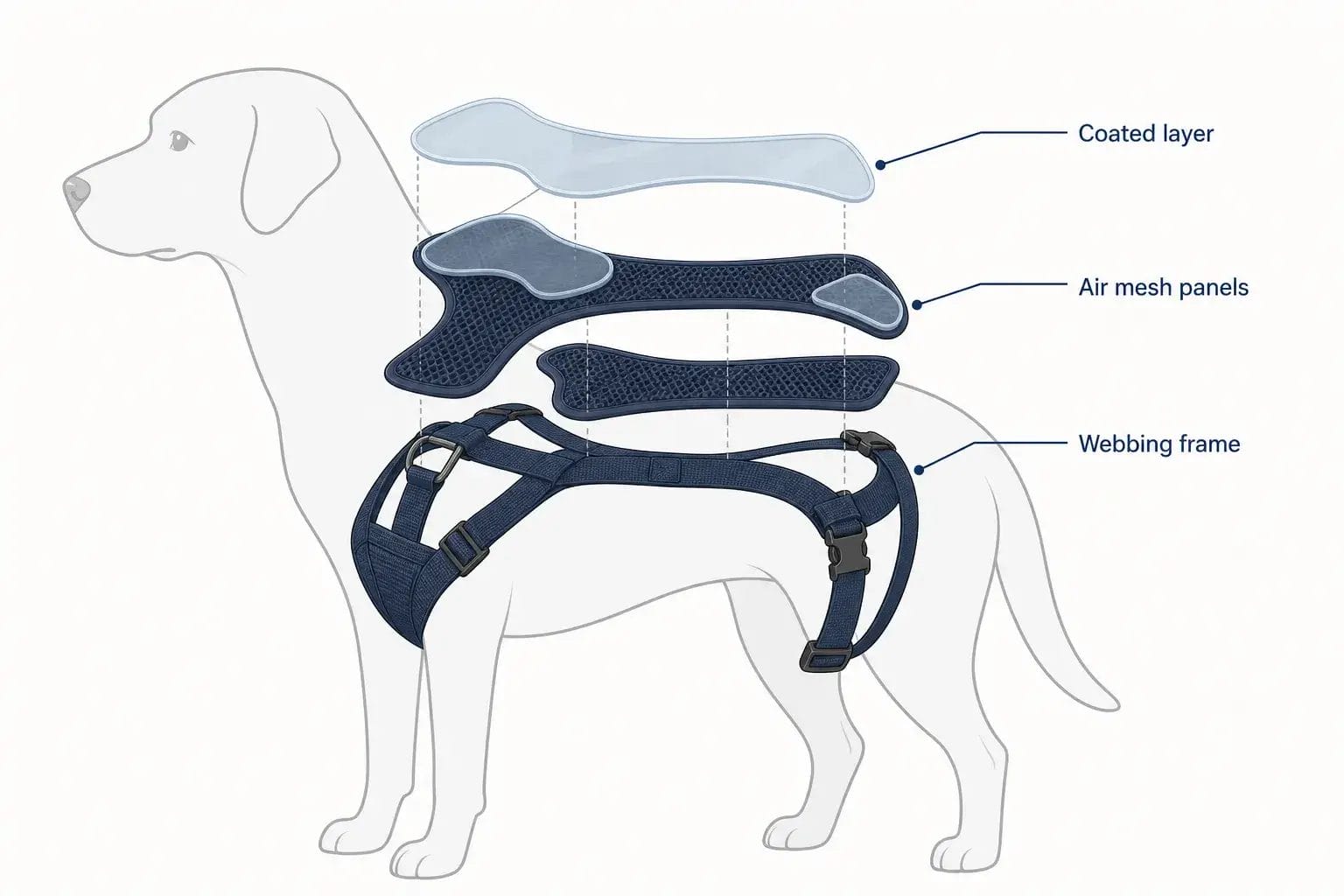
Put the three materials side by side and the layered logic of a harness becomes clear. The nylon webbing forms the skeleton — the straps that take the load and hold the hardware. Air mesh forms the panels that sit against the dog at the chest and back, adding ventilation and a cushioning layer. A coating, where the product needs it, goes over the webbing to handle water and cleaning.
A common everyday harness, for example, might use a nylon webbing frame, air mesh chest and back panels for breathability, bound edges so nothing abrades the coat, and plastic or metal hardware sized to the dog. A waterproof outdoor version of the same harness swaps the breathable panels for PVC- or TPU-coated webbing and keeps the nylon structure. The materials are not competing for the same job — each one is placed where its strength is useful. This layered, multi-material approach is the standard way harnesses are built, and getting the combination right is where design and engineering work actually happens.
Matching materials to the product: size, climate, and use case
The material mix should follow the product the brand is trying to sell. A harness for small dogs in everyday urban use can prioritize air mesh and a lighter webbing, since the loads are modest and comfort sells the product. A harness for large or strong dogs has to prioritize webbing strength and hardware, with comfort panels added on top rather than substituted in. A harness positioned for hiking, beach, or wet-weather use points toward coated webbing. A product line aimed at hot climates points toward maximizing mesh and ventilation.
Material choice also feeds straight into cost and development. Each material, coating, and finishing step carries its own cost and its own sampling considerations, so the material specification is one of the earliest things worth settling with a manufacturer.
Before confirming a material mix, a brand has a few things worth answering plainly. What dog size and pull force is the harness built for — that sets the webbing spec. Which areas touch the dog directly — that decides where comfort panels go. Does the product need water resistance or quick cleaning — that decides whether a coating belongs in the build at all. And which market is it sold into — the EU, California, or elsewhere — since that governs which coatings and chemicals are acceptable. Answering those before the first sample turns a vague “make it durable and comfortable” brief into something a factory can actually build and quote. A factory that can talk through these trade-offs — and explain how a given material mix affects durability, comfort, and compliance — is doing development work rather than just taking an order, a distinction explored in how to choose a pet product OEM manufacturer. For a fuller view of pet product development, see Pet Product Development: A Complete Guide from Concept to Production.
FAQ
What is the best material for a dog harness?
There is no single best material. A harness combines materials by function — nylon webbing for structure, air mesh for breathable comfort panels, and a PVC or TPU coating where water resistance is needed. The right mix depends on the dog’s size, the climate, and how the harness will be used.
Is air mesh durable enough for a dog harness?
Air mesh is comfortable and breathable but is not a load-bearing material. It works well as chest and back panels or as a lining, but it should not carry the pulling force. In a well-designed harness, nylon webbing handles the structure and mesh handles comfort.
Will a nylon harness chafe a dog?
Nylon webbing itself is strong and flexible, but a sharply heat-sealed cut edge can abrade fur. Bound edges and a mesh or padded lining against the body prevent this, which is why edge finishing is part of the material decision.
Are PVC-coated dog harnesses safe?
A PVC-coated harness is not automatically unsafe — the coating chemistry is what matters. PVC coatings can involve plasticizers, including phthalates that may be restricted or require warnings in markets such as the EU or California. A PVC- or TPU-coated harness should be checked against the target market’s chemical requirements during development; the material name alone does not settle it.
Can one harness use more than one material?
Yes — multi-material construction is the standard approach. A typical harness uses nylon webbing for the frame, air mesh for comfort panels, and a coating where water resistance is needed. Each material is placed where its strength is useful.
How do I communicate harness material specifications to a manufacturer?
Specify the role of each material — structural webbing, comfort panels, coating — rather than naming one fabric. Also state the target market, since that affects which coatings and chemicals are acceptable. A manufacturer that asks these questions is approaching the project as development work.
To discuss the right material mix for a specific harness design, you can talk it through with the CrazyPaws team.