
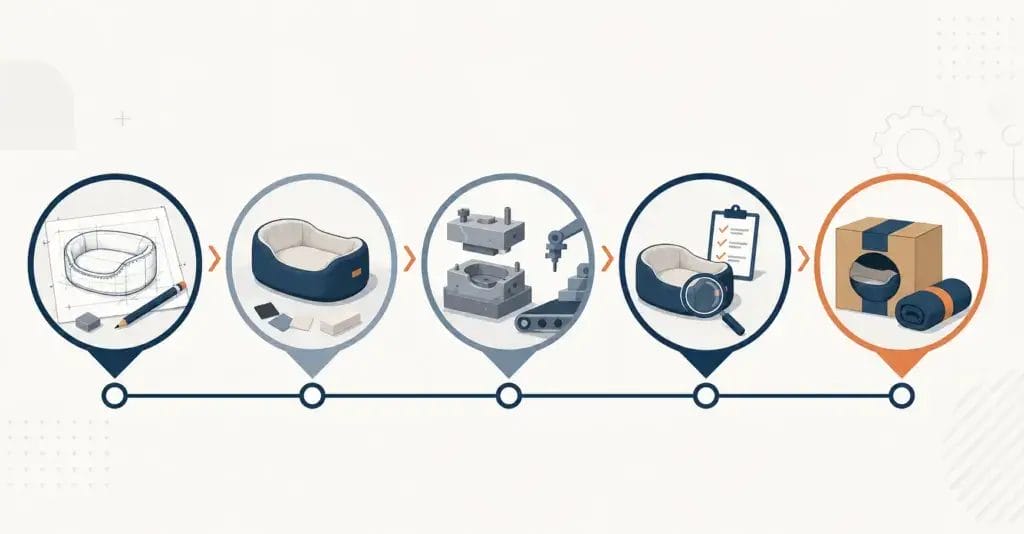
A pet product manufacturing timeline runs about three to six months, from a finalized design to a shipped first order. Soft-goods items such as harnesses and leashes sit near the shorter end; products that need custom tooling, molded parts, or compliance testing sit at the longer end.
The work breaks into five stages: design finalization and the first sample, sample revision rounds, tooling and fixtures, the pre-production sample and golden sample sign-off, and mass production with shipping. How long the whole thing runs depends far more on what the product is than on how fast any single factory works. The sections below walk through each stage, what happens in it, and where buyers most often misjudge the schedule.
How long does it take to go from prototype to mass production?
Three to six months is a reasonable planning window for a typical pet product, but the range exists for a reason. Two variables move it more than any other.
The first is structural complexity. A flat-webbing leash with standard hardware can skip tooling entirely and reach production in a couple of months. A feeding product with a custom-molded base, a snap-fit lid, and a silicone seal carries weeks of mold work that a soft-goods item simply does not have. The second is how locked-down the design is when production planning starts. A specification that is still moving — material not chosen, dimensions not final, color not confirmed — pushes every later stage out, because each unresolved detail eventually becomes a sample round or a tooling revision.
| Stage | Typical timing | What happens |
|---|---|---|
| Design finalization & first sample | 1–2 weeks | Specs are confirmed and the first sample is built |
| Sample revision rounds | 5–10 days per round | Structure, fit, material, color, and finishing are refined |
| Tooling & fixtures | 4–8 weeks if required | Molds or fixtures are built and checked |
| Pre-production / golden sample | Varies | A production-ready sample is approved |
| Mass production & shipping | 3–6 weeks plus freight | Bulk production, inspection, packing, and transit |
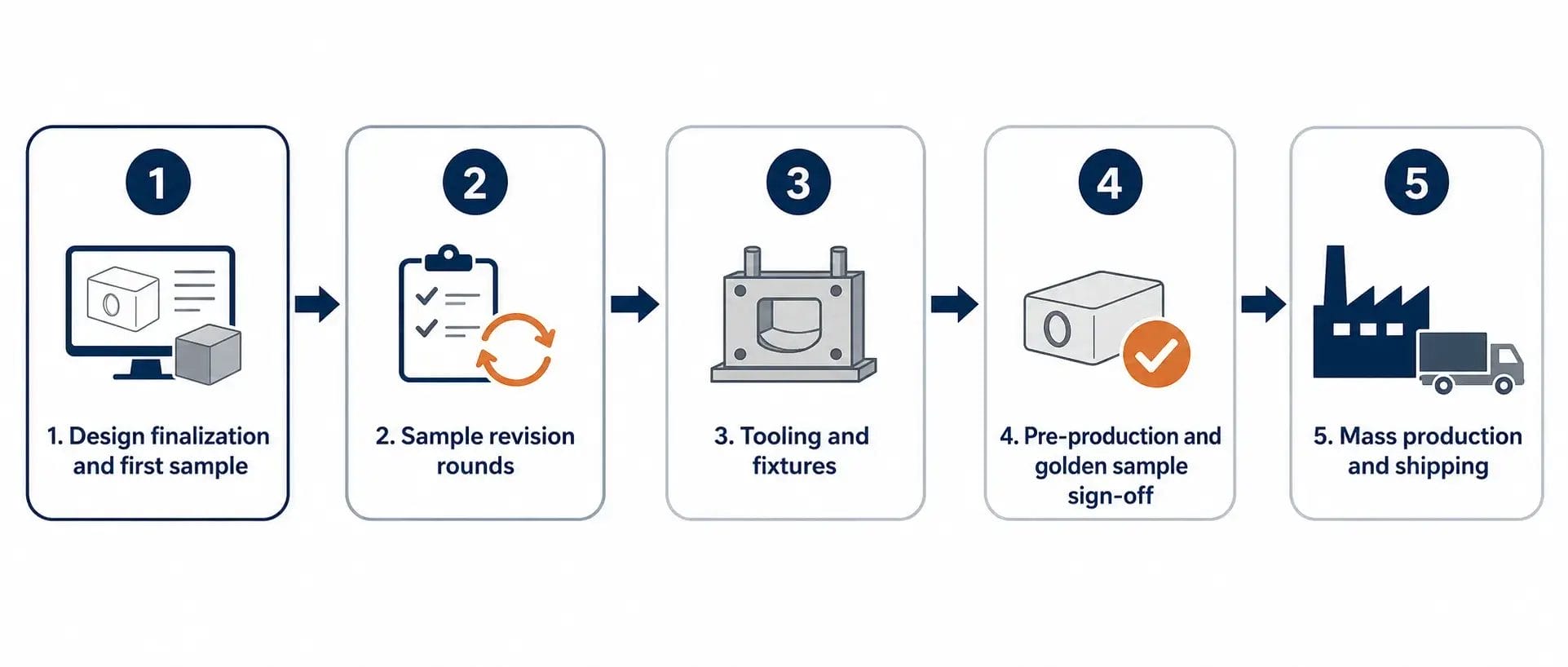
One note on the word “prototype.” Buyers often call this the “prototype to mass production” stage, but the practical clock starts a little later than the phrase suggests — once the design is detailed enough for a factory to actually sample it. A loose concept sketch is not yet at the start of this timeline; a finalized specification is.
It also matters where you start counting. Buyers planning a launch often hear “lead time is 30 days” and assume that means thirty days from approving the design. It does not. Production lead time is almost always quoted from the point of sample approval — the golden sample sign-off — not from the start of the project. Everything before that, the sampling and tooling, sits outside that number. Read the schedule with that line in mind: sample approval opens the production clock, and sampling, revisions, tooling, and testing all sit before it.
Stage 1: Design finalization and the first sample
Before anything is sampled, the design has to be turned into something a factory can build from: dimensions, materials, hardware, stitching or assembly method, tolerances. For an OEM project the brand supplies this specification; for an ODM-based project the manufacturer’s existing structure fills in much of it. Either way, the cleaner the specification, the cleaner the rest of the timeline — which is one of the practical consequences of the difference between OEM and ODM.
Once the specification is set, the factory produces a first sample. For a soft-goods pet product this typically takes one to two weeks: the materials are sourced, the pattern is cut, and the item is hand-assembled so the brand can see and handle a physical version of the design. The first sample is not meant to be perfect. Its job is to surface what looks right on paper but does not hold up in three dimensions — a buckle that sits awkwardly, a strap that twists, a panel that puckers.
Stage 2: Sample revision rounds — and why more than one is normal
Almost no pet product goes from first sample straight to production. Two to three revision rounds is normal, and a more involved product can need more. Each round usually adds five to ten days, since the factory is re-sourcing or re-cutting and reassembling.
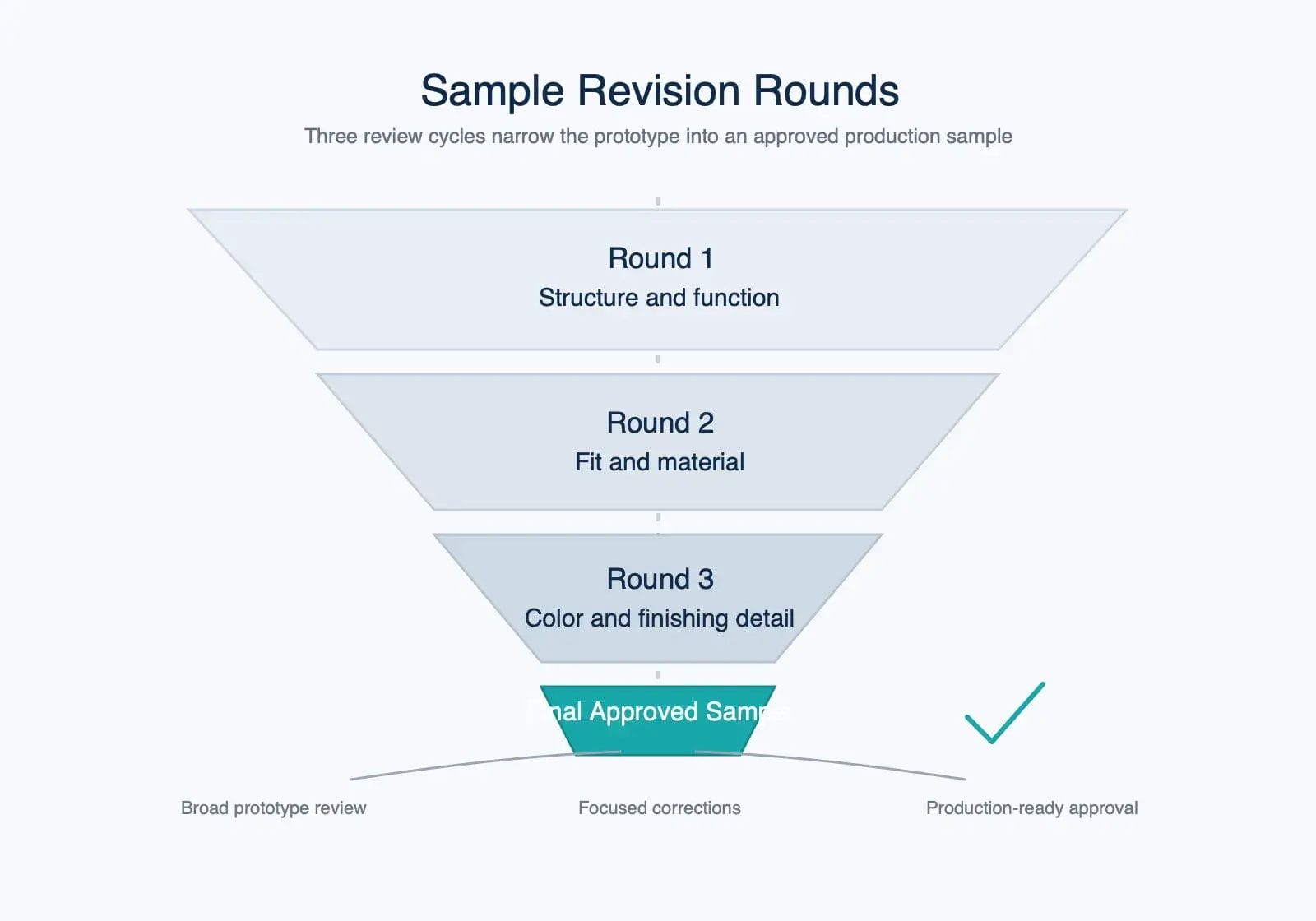
This is not inefficiency. Each round is checking a different layer. An early round is structural — does the thing hold together, does it function, does the closure work. A middle round is about fit and material — how the product sits on the animal, how a fabric behaves after handling, whether a webbing width feels right. A later round closes out detail: color accuracy, logo placement, trim, finish. Collapsing all of that into a single round tends to mean a problem gets missed and resurfaces later, when it is far more expensive to fix.
The number of rounds is also a useful signal about the factory. A manufacturer that asks pointed questions during sampling and pushes back on a spec that will not produce well is doing development work, not just order-taking — the distinction explored in how to choose a pet product OEM manufacturer.
Stage 3: Tooling and fixtures — when your product needs a mold
This stage is the single biggest fork in the timeline, because some products go through it and some skip it entirely.
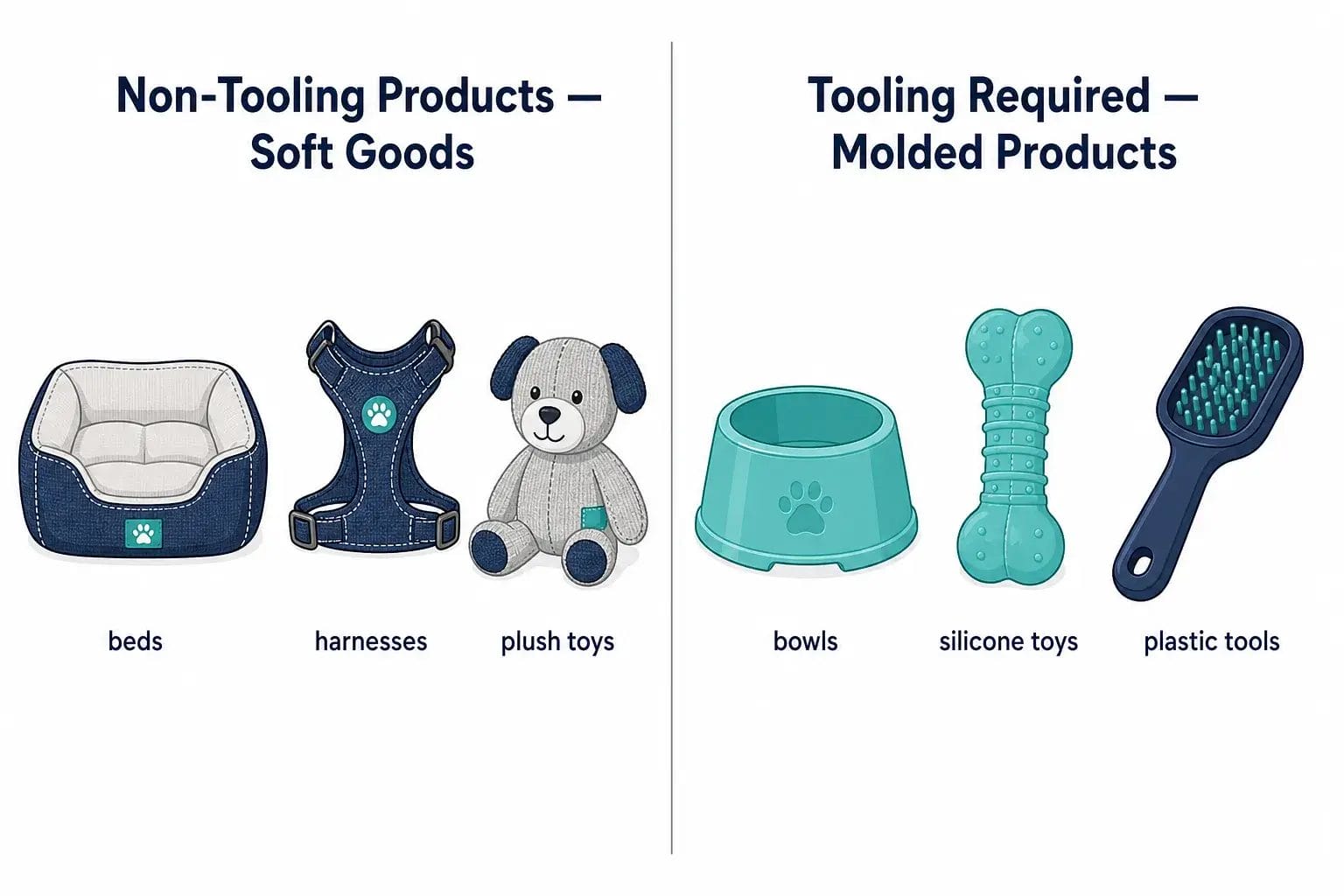
Products with rigid molded parts — many feeding products, hard components, injection-molded buckles or housings — need tooling: a steel mold machined to the exact shape of the part. Tooling design and fabrication commonly runs four to eight weeks, and longer for complex geometry with undercuts, embossed detail, or multiple cavities. Production cannot start until the mold is finished and the parts it produces have been checked. Soft-goods products — harnesses, leashes, collars, fabric carriers — usually have no molded parts and skip this stage altogether, which is a large part of why they reach production faster.
Tooling also raises a question that is contractual, not just technical: who owns the mold. Mold ownership decides whether you can move the product to another factory later, and it sits alongside the broader IP questions that come with any manufacturing model. If your product needs tooling, settle ownership in writing before the mold is cut.
Stage 4: Pre-production sample and the golden sample sign-off
Once tooling is done — or, for a soft-goods product, once revisions have closed out — the factory produces a pre-production sample using the actual production materials, the actual mold, and the actual line setup. This is the last sample before bulk, and it has a specific purpose: to confirm that what the production line will repeatedly produce matches what was approved.
Approving this sample in writing creates the golden sample — the physical reference both sides measure the bulk order against. Compared with tooling or bulk production, this stage is usually short, and much of its duration is review time on the buyer’s side rather than factory work. But it should be treated as a formal approval gate, not a casual sample check. The golden sample sign-off is the most important node in the whole timeline, and not because of how long it takes. It is important because it is the point where the production clock actually starts. A sample approved on real materials and real tooling leaves the line with few variables left to resolve, which is what makes the downstream lead time hold. A sample approved loosely, on stand-in materials or a rushed look, tends to surface problems mid-production — exactly when they cause the most delay. Stable lead times are usually the result of a disciplined sample stage, not a fast factory.
Stage 5: Mass production and shipping
With the golden sample signed off and the deposit placed, bulk production begins. For most pet products the production run itself takes somewhere around three to six weeks, depending on order quantity and structural complexity — and this is the number that the quoted “lead time” refers to.
Order quantity interacts with this stage in ways worth planning for, since both the production schedule and the cost structure shift with volume — the mechanics of which are covered in how pet product MOQ is calculated. After production, the order goes through final quality inspection, then packing, then shipping. Sea freight is its own line item: depending on the lane, ocean transit and customs clearance can add several weeks on top of the production schedule. A launch date should be set from the arrival of goods, not the end of production.
What slows a pet product timeline down — and how to plan around it
Most timeline overruns are not random factory failures. They come from a short list of recurring causes, and all of them are easier to manage if you see them coming.
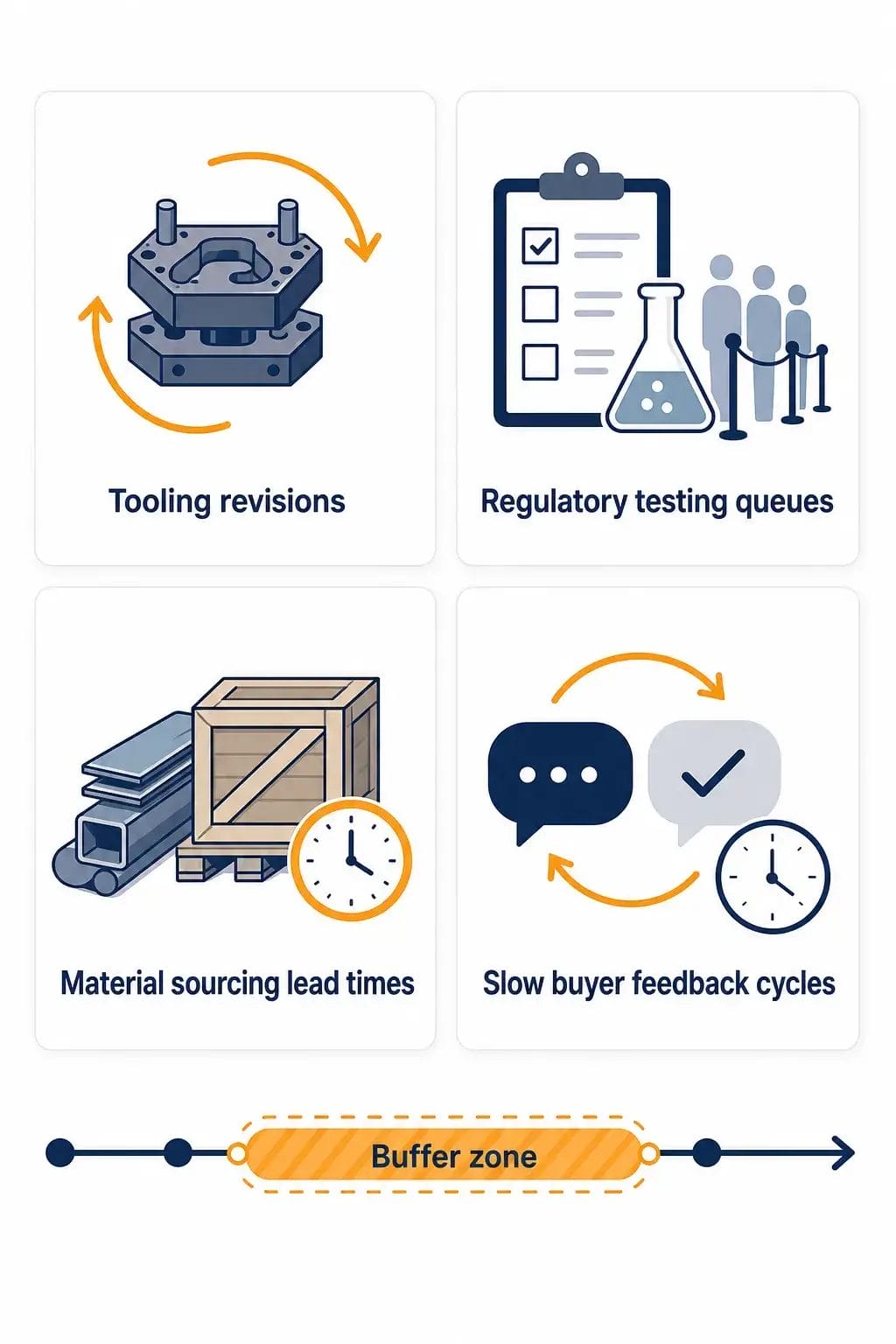
A specification that is not locked down is the most common cause. Every detail left open — material, dimension, color, hardware — eventually becomes a sample round or a tooling change, and those compound. Endless revision is the next one. Each extra sample round is real calendar time, so it pays to consolidate feedback and close issues in as few rounds as the product honestly allows. Peak season is a third. Factory lines fill ahead of major retail calendars, and a project landing in a crowded window waits longer for line time regardless of how simple it is. Compliance testing is the fourth. If the destination market requires lab testing, that runs on its own schedule and needs to be slotted in early rather than discovered late — what each market expects is laid out in Pet Product Compliance by Market: US, EU, and Japan, available at pet product compliance by market.
The practical response is to build a buffer. Two to three weeks of slack on top of every quoted figure absorbs the normal slippage, and a first international order should never be scheduled as a just-in-time launch. The timeline is a planning tool, not a guarantee — treat it that way and most of the surprises stop being surprises.
FAQ
How long does it take to manufacture a pet product from prototype to mass production?
For a typical pet product, plan on three to six months from finalized design to a shipped first order. Soft-goods items like harnesses and leashes sit at the shorter end; products needing custom tooling sit at the longer end.
How many sample rounds are normal before mass production?
Two to three revision rounds is normal, with more involved products sometimes needing additional rounds. Each round checks a different layer — structure, then fit and material, then finishing detail — and each typically adds five to ten days.
Does every pet product need tooling or a mold?
No. Products with rigid molded parts, such as many feeding products and hard components, need tooling that adds four to eight weeks. Soft-goods products like harnesses, collars, and fabric carriers usually have no molded parts and skip the stage entirely.
Does the quoted lead time start when I place the order?
Usually not. Production lead time is quoted from sample approval — the golden sample sign-off — not from the start of the project. Sampling and tooling happen before that point and should be counted separately.
Will peak season affect my timeline?
Yes. Factory lines fill ahead of major retail calendars, so a project landing in a busy window can wait longer for production capacity. Confirming the schedule against the factory’s calendar early helps avoid this.
How can I tell if a manufacturer’s quoted timeline is realistic?
A dependable timeline comes from a factory that quotes lead time from sample approval, accounts for tooling and shipping separately, and runs a disciplined sample stage rather than promising speed. A quote with no buffer and no mention of the sampling phase is worth questioning.
To discuss the development timeline for a specific pet product, you can talk it through with the CrazyPaws team.